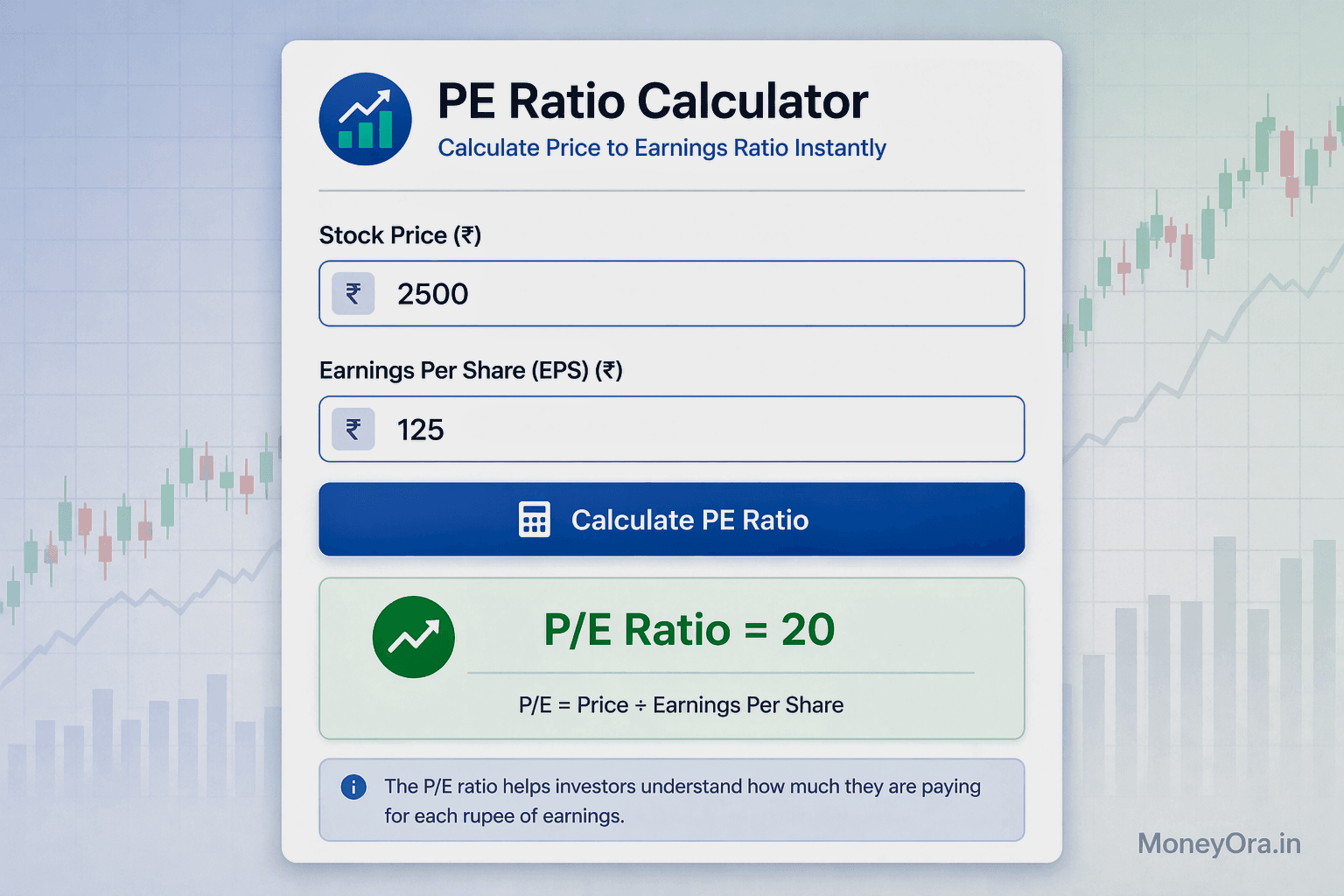
P/E Ratio Calculator – Free | MoneyOra
Free · Instant · No sign-up

P/E Ratio Calculator

Calculate Price-to-Earnings ratio, find fair value, compare with industry & screen stocks by valuation — all free.

Stock Parameters
₹1₹10,000
₹0.1₹500
P/E Ratio
Price ÷ EPS
Enter values to see verdict
Comparing with industry average
Valuation Meter
Deep Value Fair Expensive
earnings
EPS (Earnings)
Market Premium
Share Price
P/E Ratio
Share Price
EPS
Industry Avg P/E
vs Industry
Earnings Yield (EPS / Price)
🏢 NSE Industry P/E Benchmarks — tap to apply
P/E Scenario Analysis
What price implies what P/E multiple at current EPS
Current P/E
Industry Avg
Earnings Yield
P/E MultipleImplied Pricevs Current PriceVerdictEarnings Yield
Fair Value Parameters
%
0%50%
x
5x80x
1-Year Fair Value
EPS × growth × P/E
Calculating...
Based on projected EPS
1-Year Target Price
3-Year Target Price
Proj. EPS (1yr)
Proj. EPS (3yr)
Upside/Downside
Current P/E
Margin of Safety (20% buffer)
Multi-Year Price Projection
EPS growth path & fair value at target P/E
YearProj. EPSFair Value (@ P/E)Upside from CMPCAGR Required
Compare Up to 4 Stocks
Stock A
Stock B
Stock C
Stock D
Side-by-Side P/E Comparison
Ranked from cheapest to most expensive by P/E
RankStockPriceEPSP/E RatioEarnings YieldVerdict
P/E Ratio
Scroll up to adjust ↑

PE Ratio Calculator: Calculate Stock Fair Value & P/E Ratio Online

A PE Ratio Calculator is the simplest tool to find if a stock is cheap or expensive.
You're looking at a stock. It's trading at ₹500. Your friend says it's cheap. But is it really?
Without knowing its PE ratio, you can't tell.

The PE Ratio Calculator answers this question instantly.
PE ratio—or price-earnings ratio—tells you if a stock is expensive or cheap compared to its earnings.
A PE Ratio Calculator lets you compute this in seconds instead of manual calculation.
When you know the stock's PE ratio, you know its real value.

You can compare it to other stocks. You can spot overpriced stocks before they crash.
Our free PE Ratio Calculator helps Indian stock traders and investors make smarter decisions.
Let's learn how the PE ratio calculator works and how to use it.

Free PE ratio calculator showing how to calculate P/E ratio for stocks online

What Is PE Ratio? Understanding Price-Earnings Ratio

The PE ratio (price-earnings ratio) is the simplest way to understand if a stock is expensive or cheap.
PE Ratio Formula:
PE Ratio = Stock Price ÷ Earnings Per Share (EPS)
That's it. Just two numbers.

Real Example:
Company XYZ stock price: ₹1,000 Company XYZ earnings per share (EPS):
₹100 PE Ratio = ₹1,000 ÷ ₹100 = 10
This means you're paying ₹10 for every ₹1 of earnings the company makes.

What Does This Mean?
A PE ratio of 10 means the stock would pay back your investment in 10 years (if earnings stay the same).
A PE ratio of 20 means 20 years to pay back.
A PE ratio of 5 means only 5 years.
Lower PE ratio = cheaper stock. Higher PE ratio = more expensive stock.
But there's a catch. Higher PE doesn't always mean bad. Sometimes high PE is justified.

Why Use a PE Ratio Calculator?
Manual calculation takes time. You need:
  ●Current stock price (easy to find)
  ●Earnings per share (need to look up)
  ●Divide them (mental math or calculator)
A PE ratio calculator automates this. Input the numbers, get the answer instantly.
Most Indian investors use a PE ratio calculator because it's fast and error-free.

How to Calculate PE Ratio? Manual Method vs PE Ratio Calculator

Let's compare two methods: doing it manually and using a PE ratio calculator.

Manual PE Ratio Calculation (The Hard Way)

Step 1: Find the stock price.
  ●Easy. Just check NSE or BSE.
  ●Example: TCS stock = ₹3,500Step

2: Find earnings per share (EPS).
  ●Check the company's latest financial results.
  ●Look at "EPS" in the balance sheet or quarterly report.
  ●Example: TCS EPS = ₹350Step

3: Divide.
  ●₹3,500 ÷ ₹350 = 10
  ●PE Ratio = 10Step

4: Interpret.
  ●A PE of 10 means TCS is relatively cheap.
  ●Compare to industry average (IT sector average might be 15-20).
Time Taken: 5-10 minutes.
Accuracy Risk: Human calculation errors.
Comparison Time: Even longer if checking multiple stocks.

Using a PE Ratio Calculator (The Smart Way)
Step 1: Open PE ratio calculator.
Step 2: Enter stock price: ₹3,500
Step 3: Enter EPS: ₹350
Step 4: Click "Calculate"
Step 5: Instant result: PE Ratio = 10
Time Taken: 30 seconds.
Accuracy: Perfect (no human error).
Comparison Time: Can check 20 stocks in 10 minutes.

Why Use a PE Ratio Calculator?
  ●Faster than manual calculation
  ●No arithmetic errors
  ●Can compare multiple stocks quickly
  ●Most Indian brokers now offer PE ratio calculator tools
Professional investors always use a PE ratio calculator.
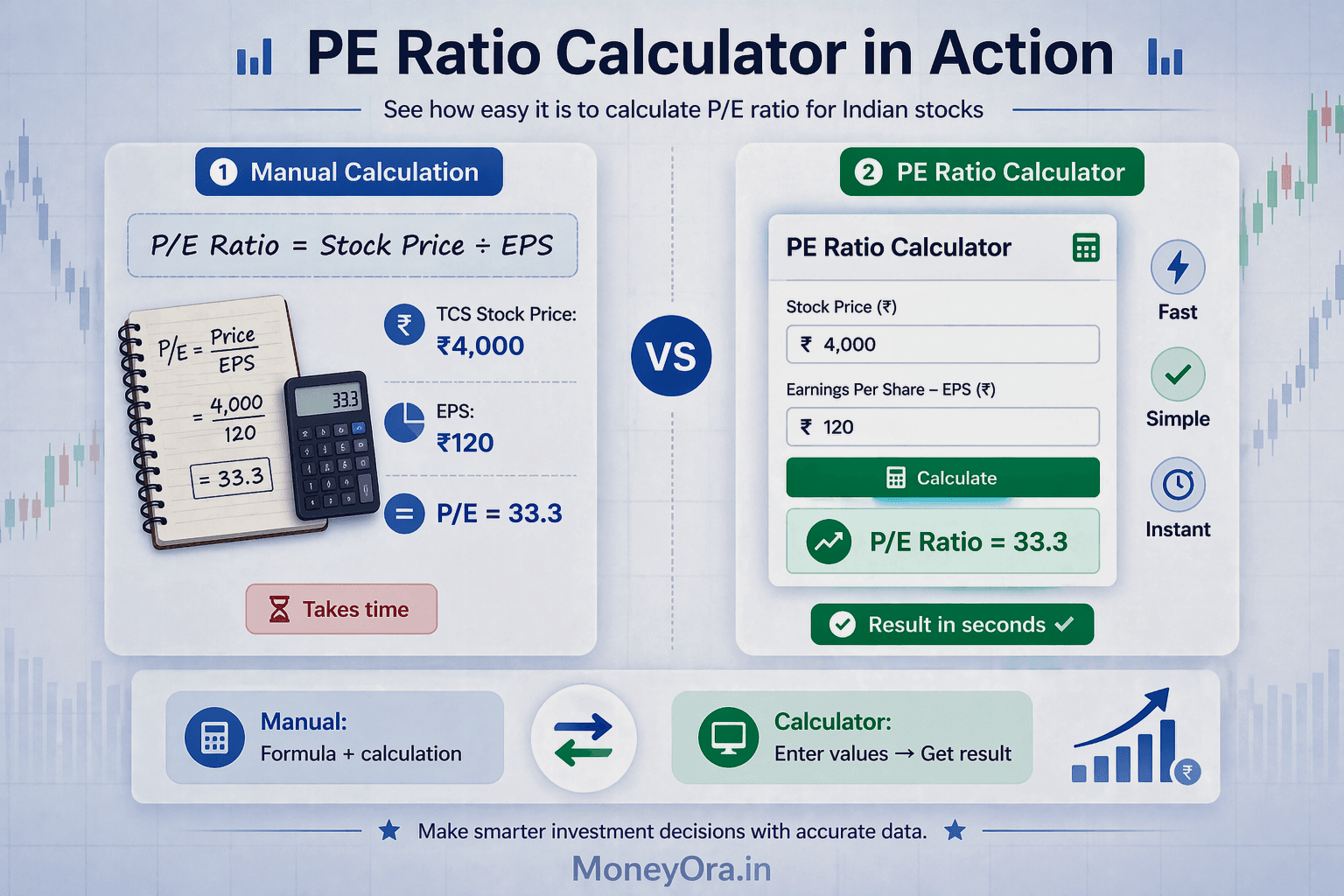

PE ratio calculator showing calculation of P/E ratio for TCS and other Indian stocks

How to Use Our Free PE Ratio Calculator? Step-by-Step Guide

Our free PE ratio calculator is simple. No complicated inputs. Just the essentials.

Step 1: Enter Current Stock Price

Type the current market price of the stock.

Example: Reliance Industries = ₹2,800

The PE ratio calculator needs the latest price. This can change daily, so check the live price.


Step 2: Enter Earnings Per Share (EPS)

EPS is how much profit the company earned per share in the last year.

Where to find EPS:

  • Company’s quarterly/annual report
  • NSE website (stock info page)
  • Your broker’s app
  • Financial websites like Moneycontrol or Screener

Example: Reliance EPS (last 12 months) = ₹280

The PE ratio calculator uses this to compute the ratio.


Step 3: Click “Calculate”

Hit the calculate button. The PE ratio calculator instantly shows:

  • PE Ratio: Your calculated P/E ratio
  • Interpretation: What this PE ratio means
  • Comparison: How it compares to market average

Example Result:

  • Stock Price: ₹2,800
  • EPS: ₹280
  • PE Ratio: 10
  • Interpretation: Below market average (cheaper)
Step 4: Compare & Decide

Now use the PE ratio calculator result to decide:

Is this stock cheap?

  • If PE < industry average: Likely undervalued
  • If PE > industry average: Likely overvalued
  • If PE = industry average: Fairly valued

Example from PE ratio calculator:

  • Reliance PE: 10
  • Oil & Gas industry average: 12
  • Conclusion: Reliance is cheaper than peers (good value)

That’s how to use the PE ratio calculator for smart investing.

“Calculate your stock investment returns using CAGR calculator”

What Is a Good PE Ratio? Understanding Fair Value
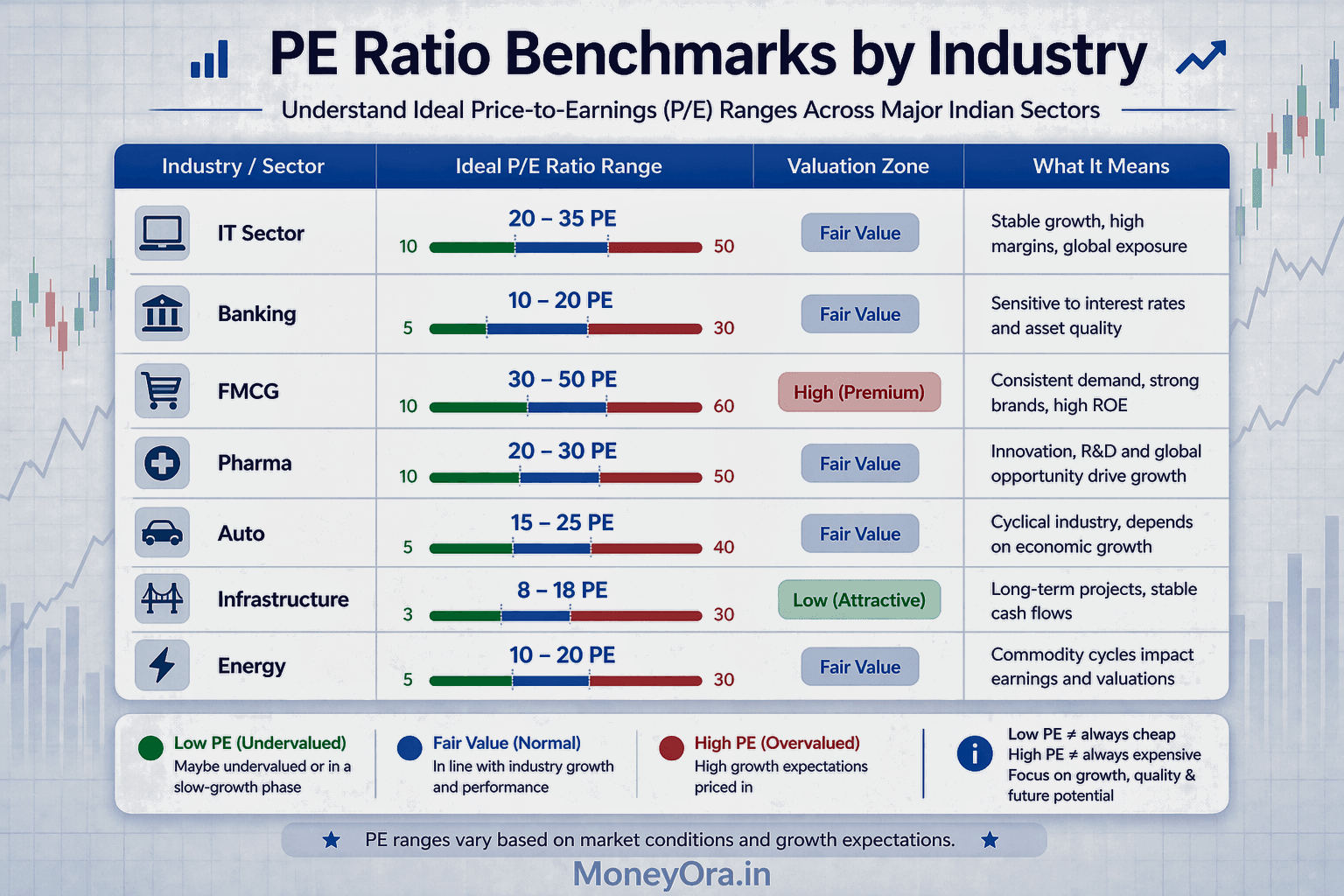
 The million-rupee question: What PE ratio is “good”?

The answer: It depends.

A good PE ratio changes based on:

  • Industry
  • Company growth rate
  • Market conditions
  • Economy phase

PE Ratio by Industry

Different sectors have different average PE ratios.


High Growth Industries (Higher PE is Normal):

  • IT companies: 20-30 PE ratio
  • Pharma: 25-35 PE ratio
  • E-commerce: Can be 50+ (if profitable)

Example: TCS might trade at PE 25, which is reasonable for IT.


Mature, Stable Industries (Lower PE is Normal):

  • Banks: 12-18 PE ratio
  • Oil & Gas: 8-12 PE ratio
  • Utilities: 8-15 PE ratio

Example: SBI might trade at PE 14, which is normal for banking.


How to Use PE Ratio Calculator for Comparison:

Use the PE ratio calculator for multiple stocks in the same industry.

Example:

  • TCS PE (from calculator): 25
  • Infosys PE (from calculator): 28
  • HCL PE (from calculator): 22

Conclusion: HCL looks cheaper than competitors despite being in the same industry.


Groww PE Ratio & What Others Use

Popular platforms like Groww show PE ratio. But they don’t explain the context.

Use MoneyOra’s PE ratio calculator to:

  • Calculate your own PE ratio (verify numbers)
  • Compare to industry benchmarks
  • Make informed decisions

A PE ratio of 25 for TCS is reasonable. The same PE of 25 for a bank would be very expensive.

Context matters. The PE ratio calculator helps you understand that context.

“Plan your monthly SIP investments with our SIP calculator”

PE ratio calculator showing good PE ratio ranges for Indian stocks by sector and industry

Forward PE Ratio vs Trailing PE Ratio - Which to Use?

Here’s where it gets interesting. There are two types of PE ratios.

Trailing PE Ratio (Historical)

Trailing PE Ratio = Stock Price ÷ Last 12 Months of Earnings

This uses past earnings. It’s the actual earnings the company made.

Example:

  • Stock Price: ₹1,000
  • Earnings in last 12 months: ₹100
  • Trailing PE: 10

Advantages:

  • Based on actual, confirmed earnings
  • No guessing or estimates
  • Easy to verify from balance sheets

Disadvantages:

  • Doesn’t account for future growth
  • Misleading if earnings just crashed

Forward PE Ratio (Future Estimate)

Forward PE Ratio = Stock Price ÷ Next 12 Months Earnings (Estimated)

This uses future earnings. It’s analysts’ estimates for the next year.

Example:

  • Stock Price: ₹1,000
  • Estimated next 12-month earnings: ₹150
  • Forward PE: 6.67

Advantages:

  • Accounts for expected growth
  • Shows if stock is cheap considering future profits
  • More relevant for growth stocks

Disadvantages:

  • Based on estimates (could be wrong)
  • Analysts are often too optimistic or pessimistic
  • Not guaranteed

Which Forward PE Ratio or Trailing PE to Use?

Use Trailing PE if:

  • You want to know actual valuation
  • The company is mature and stable
  • Earnings are predictable

Use Forward PE if:

  • The company is growing rapidly
  • You believe analyst estimates
  • You want to catch growth before it happens

Best Practice: Use both. Our PE ratio calculator lets you input either number.

If trailing PE is 15 and forward PE is 10, the stock is getting cheaper (earnings expected to grow). Good sign.

If trailing PE is 10 and forward PE is 20, the stock is expected to get more expensive (earnings expected to shrink). Bad sign.  “Calculate your monthly EMI for loans”

PE Ratio Calculator for Indian Stocks & Nifty 50
Indian stock market is unique. PE ratios here are different from global averages.

Nifty 50 PE Ratio

The Nifty 50 index has its own average PE ratio. In 2024:

  • Nifty 50 average PE: ~20-24
  • This changes based on market cycles

What This Means:

  • If a stock has PE < 20: Cheaper than market average
  • If a stock has PE > 24: More expensive than market average

You can use the PE ratio calculator to compare individual stocks to Nifty 50 average.


PE Ratio Calculator for Popular Indian Stocks

Let’s look at real examples using PE ratio calculator principles:

TCS (Tata Consultancy Services):

  • Stock Price: ₹3,500 (example)
  • EPS: ₹350
  • PE Ratio (from calculator): 10
  • Industry average: 18-22
  • Interpretation: Cheaper than peers

HDFC Bank:

  • Stock Price: ₹1,600
  • EPS: ₹120
  • PE Ratio (from calculator): 13.3
  • Industry average: 14-16
  • Interpretation: Fairly valued

Reliance Industries:

  • Stock Price: ₹2,800
  • EPS: ₹280
  • PE Ratio (from calculator): 10
  • Industry average: 12-15
  • Interpretation: Slightly cheaper

Use our PE ratio calculator for any Indian stock:

  • Nifty 50 constituents
  • Mid-cap stocks
  • Small-cap stocks
  • Any listed company on NSE/BSE

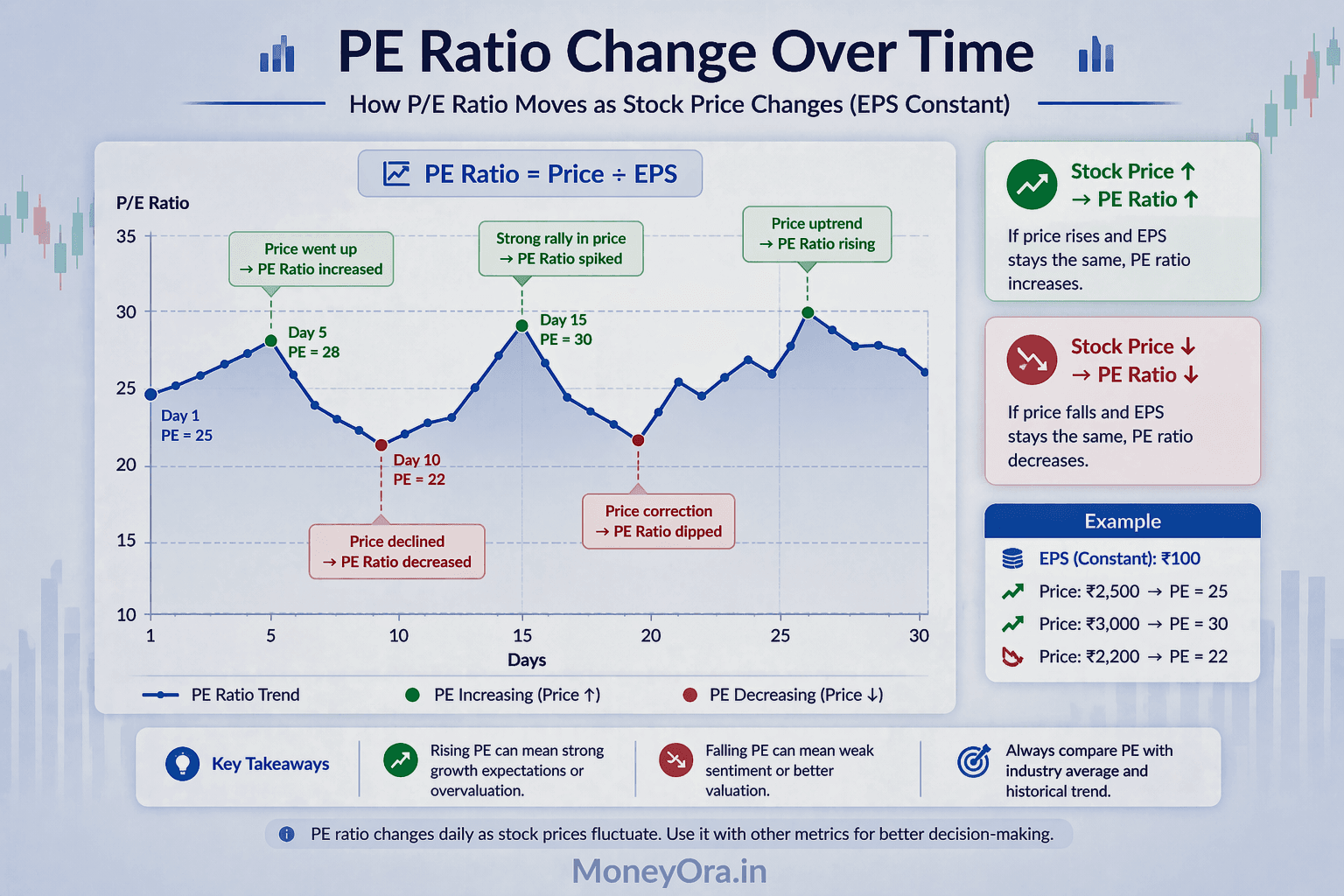
Does PE Ratio Change Daily?

Yes. PE ratio changes every day because stock price changes every day.

Why?

  • Stock price fluctuates based on buying/selling
  • EPS stays same until new earnings are announced
  • Since PE = Price ÷ EPS, any price change changes PE ratio

Example:

  • Day 1: Stock ₹1,000, EPS ₹100, PE = 10
  • Day 2: Stock ₹1,100, EPS ₹100, PE = 11
  • Stock went up 10%, PE ratio went up too

Use the PE ratio calculator fresh each time. Don’t rely on yesterday’s PE ratio.
“Check your home loan EMI before investing”

PE ratio calculator showing how P/E ratio changes daily as stock price fluctuates for Indian stocks

Common PE Ratio Mistakes Investors Make


After analyzing hundreds of Indian investors, we see the same mistakes repeated.

Mistake 1: Comparing PE Ratios Across Industries

Investor compares:

  • Bank PE: 14
  • IT Company PE: 25

Thinks: “IT company is overpriced!”

Reality: Both are fairly valued for their industries.

Banks have stable, predictable earnings. IT companies grow faster. Higher PE for IT is normal.

Fix: Use PE ratio calculator to compare stocks within the same industry.

Mistake 2: Using Only Trailing PE Ratio

Investor sees:

  • Trailing PE: 25
  • Thinks: “Too expensive!”

Reality: Forward PE is 12 because earnings will double.

This stock is actually cheap if the earnings growth happens.

Fix: Use PE ratio calculator for both trailing AND forward PE. Compare them.

Mistake 3: Ignoring Company Growth Rate

Investor sees:

  • Stock A: PE = 10
  • Stock B: PE = 20
  • Buys Stock A

Reality: Stock B is growing 50% annually. Stock A is growing 5%.

Stock B is actually cheaper relative to its growth.

Better approach:

  • Use PE ratio calculator
  • Check company growth rate
  • Calculate PEG ratio (PE ÷ Growth Rate)

Mistake 4: Buying Just Because PE Is Low

Investor sees:

  • Stock PE: 5 (very low!)
  • Buys immediately

Reality: PE is low because company is in trouble. Earnings will shrink.

Low PE isn’t always good. Could be a value trap.

Fix:

  • Use PE ratio calculator
  • Check why PE is low
  • Look at company fundamentals too

Mistake 5: Not Updating PE Ratio Regularly

Investor calculates PE ratio once (6 months ago). Uses that old number to invest today.

Reality: Stock price changed. PE ratio changed. Old data is misleading.

Fix: Use PE ratio calculator fresh whenever deciding to buy.

“Calculate dividend income from stocks with our dividend calculator”

PE Ratio vs Other Valuation Metrics


PE ratio is useful, but it’s not the only metric. Let’s compare.

PE Ratio vs PEG Ratio

PE Ratio: Stock Price ÷ EPS (Price-Earnings) PEG Ratio: PE Ratio ÷ Growth Rate (Price-Earnings-Growth)

Example:

  • Stock A: PE = 20, Growth = 20%
  • PEG = 20 ÷ 20 = 1.0 (fair value)
  • Stock B: PE = 20, Growth = 5%
  • PEG = 20 ÷ 5 = 4.0 (overpriced)

A PE ratio calculator shows PE. But you should manually calculate PEG for growth context.

PE Ratio vs Price-to-Book Ratio

PE Ratio: Based on earnings (profit) Price-to-Book Ratio: Based on assets (book value)

PE ratio shows earning power. Price-to-book shows asset value.

Both matter. Use both with PE ratio calculator insights.

PE Ratio vs Dividend Yield

PE Ratio: Shows valuation Dividend Yield: Shows income

A stock can be expensive (high PE) but still pay good dividends.

Use PE ratio calculator for valuation. Check dividend yield separately for income.

“Track your stock investment returns using stock return calculator”

Pro Tips: Using PE Ratio Calculator for Better Investing

Here are advanced ways professional investors use a PE ratio calculator.

Tip 1: Calculate PE Ratio for Entry & Exit

Use PE ratio calculator to set buying and selling prices.

Example:

  • Stock’s fair PE ratio: 15
  • Current PE (from calculator): 20 (overpriced)
  • Don’t buy now
  • When stock drops and PE falls to 12
  • Use PE ratio calculator to confirm
  • Buy at undervalued PE

Tip 2: Track PE Ratio Changes

Use PE ratio calculator regularly. Track changes month by month.

Pattern 1: PE increasing, price increasing = Good (earnings growing faster than price) Pattern 2: PE decreasing, price increasing = Be careful (price rising without earnings growth) Pattern 3: PE stable, price stable = Boring but safe

Tip 3: Compare Peers Using PE Ratio Calculator

Every quarter, use PE ratio calculator for top 3 companies in a sector.

Identify which one is cheapest relative to peers.

Often, cheapest is also fastest growing (best value).

Tip 4: Use PE Ratio Calculator During Market Crashes

When the market crashes, PE ratios fall.

Use PE ratio calculator to find stocks that are now undervalued.

Best buying opportunities show up as low PE ratios (from calculator).

Tip 5: Calculate Historical PE Ratio Range

Find the stock’s PE range:

  • PE 2 years ago (from calculator)
  • PE 1 year ago (from calculator)
  • PE today (from calculator)

If today’s PE is near the low of that range, it’s cheap.

If today’s PE is near the high of that range, it’s expensive.  “According to RBI guidelines on stock market investments”

How to Calculate PE Ratio in Excel (For Advanced Users)

Some investors prefer Excel. Here’s how:

Excel PE Ratio Formula

Open Excel. Create three columns:

Stock NameStock PriceEPSPE Ratio
TCS3500350=B2/C2
Reliance2800280=B3/C3
HDFC Bank1600120=B4/C4

The formula =B2/C2 calculates PE ratio.

Advantages:

  • Calculate many stocks at once
  • Save historical PE data
  • Create charts and trends

Disadvantages:

  • Need to manually update stock price and EPS
  • More work than PE ratio calculator
  • Risk of formula errors

Best approach: Use PE ratio calculator for quick checks. Use Excel for tracking over time.

For more details on P/E ratio history and methodology

PRO TIPS SECTION

Pro Tip 1: Create a PE Ratio Watch List

Use PE ratio calculator to build a list of stocks you’d buy at certain PE levels.

Example:

  • TCS: Buy at PE < 20 (now PE = 25, so wait)
  • HDFC Bank: Buy at PE < 12 (now PE = 14, so wait)
  • Reliance: Buy at PE < 9 (now PE = 10, so wait)

This prevents emotional buying. You buy only when your PE ratio calculator shows your target PE.

Pro Tip 2: Use PE Ratio Calculator During Market Corrections

Market crashes often create bargains. Use PE ratio calculator to find:

  • Stocks trading at historically low PE ratios
  • Good companies at cheap prices
  • Entry points for long-term investing

Pro Tip 3: Monitor PE Ratio Changes Quarter by Quarter

Track how PE ratio changes when EPS updates.

If EPS grows 20% and stock price stays same, PE will fall. This is good for value investors.

Use PE ratio calculator each quarter. Track the trend.

Pro Tip 4: Compare PE Ratios Within a Sector

Every quarter, run PE ratio calculator for all major players in a sector.

Identify:

  • Which company looks cheapest (best value)
  • Which company is growing fastest (potential winner)
  • Which company is most expensive (possibly overpriced)

This sector analysis beats random stock picking.

Pro Tip 5: Combine PE Ratio with Dividend Yield

A high PE stock might still be worth buying if it pays good dividends.

Example:

  • Stock A: PE = 30, Dividend Yield = 2%
  • Stock B: PE = 15, Dividend Yield = 0.5%

Stock A might give better total returns (capital growth + dividends).

Use PE ratio calculator alongside dividend yield analysis. “Check stock information on NSE official portal”

COMMON MISTAKES SECTION

Mistake 1: Buying Low PE Stocks Blindly

Low PE sounds good. But sometimes it’s low for a reason.

The company might be:

  • Losing market share
  • Facing disruption
  • In a declining industry
  • About to announce bad earnings

A PE ratio calculator shows the number. But you need to understand why the PE is low.

Fix: Before buying a low-PE stock, check the company’s fundamentals.

Mistake 2: Ignoring Industry Context

A PE of 25 is expensive for a bank. It’s cheap for an IT company.

Many investors forget this. They compare PE ratios across industries and make wrong decisions.

Fix: Use PE ratio calculator to find the stock’s industry average. Compare within the same sector.

Mistake 3: Using Old EPS Data

If you use EPS from 2 years ago in the PE ratio calculator, your result is wrong.

Always use the latest EPS (last 12 months or latest quarter).

Fix: Update EPS quarterly when companies release results.

Mistake 4: Not Considering Growth

A cheap PE ratio is only good if the company has decent growth.

A stock with PE = 5 and 0% growth is a value trap.

A stock with PE = 20 and 25% growth is actually cheaper.

Fix: Always look at PEG ratio = PE ÷ Growth Rate.

Mistake 5: Panic Selling When PE Is High

Market rallies. Your stock’s PE goes from 15 to 25.

You panic and sell, thinking it’s overpriced.

Reality: The stock might still be undervalued if earnings grew proportionally.

Fix: Don’t just look at PE ratio calculator result. Look at earnings growth too.


COMPARISON TABLE:

PE Ratio Calculator vs Manual Calculation

FactorPE Ratio CalculatorManual Calculation
Speed30 seconds10 minutes
Accuracy100%Risk of errors
Multiple stocksEasy (10 stocks = 5 min)Time-consuming (10 stocks = 100 min)
Visual presentationClear, formattedNeed Excel or paper
UpdatesFresh each timeNeed to recalculate
Learning curveNone (simple inputs)Need to understand formula
Best forQuick decisionsDetailed analysis
CostFreeFree (if using Excel)

Verdict: For most investors, PE ratio calculator saves time and prevents errors.

CONCLUSION & CALL-TO-ACTION

PE ratio calculator is the simplest way to understand if a stock is cheap or expensive.

With just two numbers—stock price and EPS—you can make smarter investment decisions.

Don’t guess. Don’t follow tips blindly. Use the PE ratio calculator. Know the numbers. Invest with confidence.

Start now:

  1. Open MoneyOra’s free PE ratio calculator
  2. Enter your favorite stock’s price
  3. Enter its EPS
  4. Click “Calculate”
  5. See if it’s undervalued or overpriced

Professional investors use PE ratio calculators. Now you can too.

Ready to find undervalued stocks?

[Click here to use our free PE ratio calculator]

Or explore our other tools:

  • EMI Calculator (for loan planning)
  • SIP Calculator (for investment planning)
  • Dividend Calculator (for income calculation)
  • Stock Return Calculator (for return tracking)

Start calculating. Start investing smarter. 

FAQ - Frequently Asked Questions About PE Ratio Calculator

What Is PE Ratio Calculator?

A PE ratio calculator is a tool.

It calculates the price-earnings ratio instantly.

You enter stock price.

You enter earnings per share (EPS).

The calculator shows PE ratio.

It also helps you understand valuation.

It compares the stock with benchmarks.

How Do I Find EPS for PE Ratio Calculator?

EPS is available in company reports.

Check quarterly or annual reports.

You can also find it on NSE or BSE websites.

Financial websites like Moneycontrol or Screener provide EPS.

Broker apps like Zerodha, Angel One, and Upstox also show it.

Always use the latest EPS value.

Prefer last 12 months or latest quarter.

Does PE Ratio Change Daily?

Yes, PE ratio changes daily.

This happens because stock price changes daily.

EPS remains constant until earnings update.

So changing price divided by stable EPS changes PE.

Always use fresh data in the calculator.

What Is a Good PE Ratio for Indian Stocks?

It depends on the industry.

Bank PE: 12–18 is normal.

IT company PE: 18–30 is normal.

Pharma PE: 20–35 is normal.

Oil & Gas PE: 8–15 is normal.

Nifty 50 average PE is around 20–24.

Compare your stock with its industry.

Can PE Ratio Be Negative?

Yes, PE can be negative.

This happens when company has losses.

Example: price ₹100 and EPS -₹10.

PE becomes -10.

This indicates the company is losing money.

It is generally a red flag.

Should I Use Trailing or Forward PE Ratio?

Use both for better analysis.

Trailing PE uses past earnings.

It is more reliable.

Forward PE uses future estimates.

It shows growth expectations.

If forward PE is lower, growth is expected.

How Often Should I Check PE Ratio?

Check before buying a stock.

Check every quarter when EPS updates.

Check before selling.

Check during market corrections.

Focus on trends instead of daily changes.

What’s the Difference Between PE and PEG Ratio?

PE ratio shows valuation.

PEG ratio shows valuation vs growth.

PEG = PE ÷ Growth rate.

A PEG near 1 is considered fair.

Use both for better analysis.

Can I Use PE Ratio Calculator for Mutual Funds?

No, not directly.

Mutual funds do not have a single PE.

They hold multiple stocks.

You can check average PE of holdings.

Or use fund-level valuation metrics.

What If Two Stocks Have the Same PE Ratio?

Compare other factors.

Growth rate should be higher.

Profit margins should be strong.

ROE should be higher.

Debt should be lower.

PE is only one metric.

Use it with other analysis.