
Loan EMI
Calculator
Monthly instalments for any currency — Home, Car, Personal & Education loans.
| Year | Principal | Interest | Total | Balance |
|---|
EMI Calculator 2026: Formula, Real Examples & 7 Proven Ways to Lower Your Monthly Loan EMI
Published: August 2026 | Category: Financial Calculators | Reading Time: ~14 min
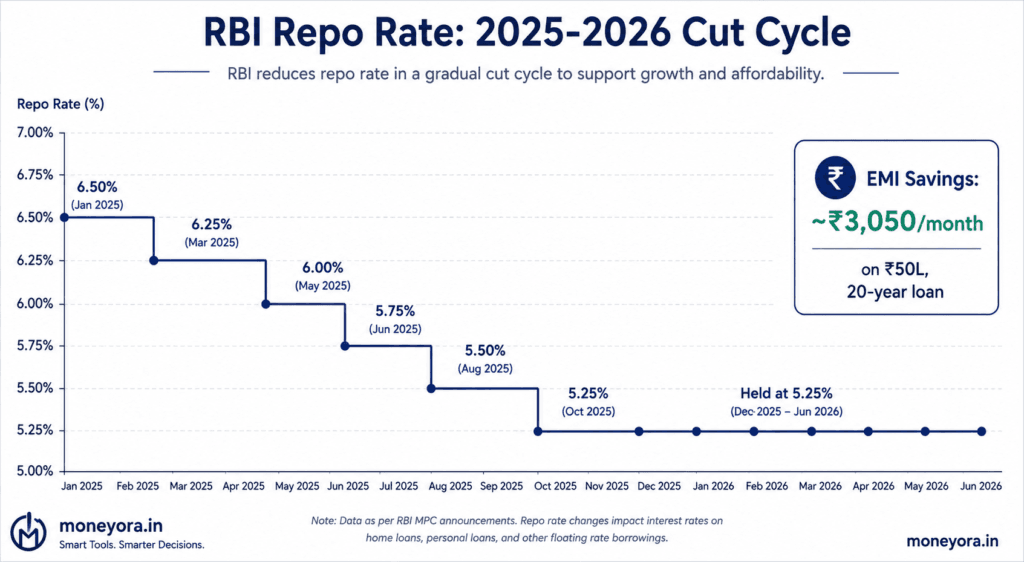
The RBI cut the repo rate by a cumulative 125 basis points through 2025 from 6.50% down to 5.25%, where it has held steady through mid-2026. If you took a home loan before that cycle and your EMI hasn’t changed, there’s a real chance you’re overpaying every single month. Most people never check.
An EMI Calculator is the fastest way to catch that gap and to plan any new loan before you sign for it. This guide walks through the exact EMI formula, real worked examples for home, car, and personal loans, what actually happens inside your EMI every month, and seven practical ways to bring your EMI down. Not generic tips actual numbers you can apply today.
Skip the manual math. Use MoneyOra’s free EMI Calculator to get your exact monthly payment in seconds.
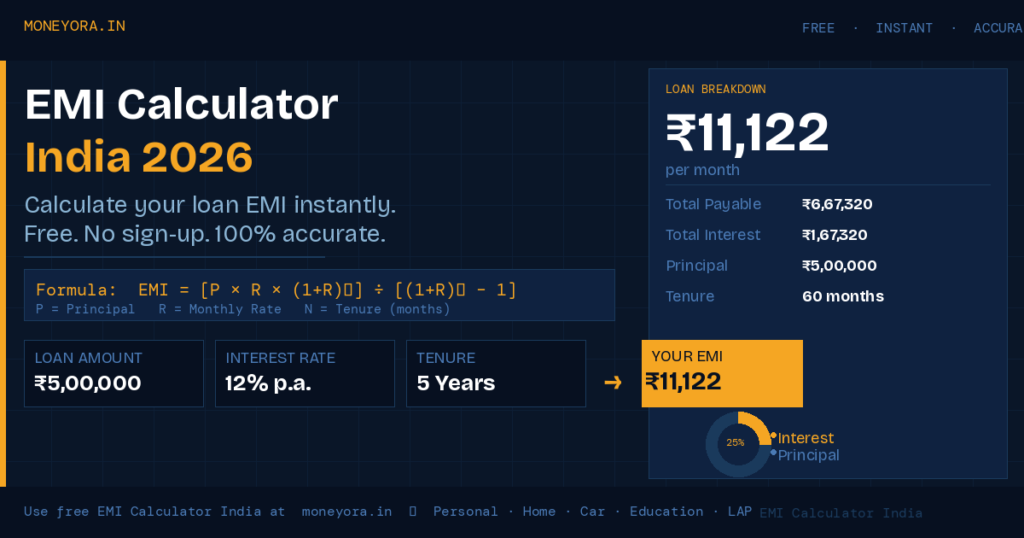
- EMI is calculated using the formula EMI = [P × R × (1+R)^N] / [(1+R)^N − 1], where P is principal, R is monthly interest rate, and N is tenure in months.
- The RBI repo rate stood at 5.25% as of June 2026, unchanged since December 2025, after a 125 bps cut cycle through 2025.
- For a ₹50 lakh, 20-year home loan, that 125 bps rate cut alone saves borrowers roughly ₹3,050 per month but only if your loan resets automatically.
- EBLR-linked loans reset within 1–3 months of an RBI rate change; MCLR-linked loans reset only once a year check which one you’re on.
- In the early years of any loan, most of your EMI goes toward interest, not principal understanding this changes how you should prepay.
- A longer tenure lowers your EMI but sharply increases total interest paid the trade-off is rarely explained clearly.
What is an EMI?
EMI stands for Equated Monthly Installment. It’s the fixed amount you pay every month until a loan is fully repaid.
Walk into SBI, borrow ₹5 lakh. They don’t expect a lump sum next month. Instead, they divide the repayment into equal monthly chunks across your agreed tenure. Each chunk is an EMI.
Two things make up every EMI:
- Principal — the actual loan amount you’re chipping away at
- Interest — what the bank charges for lending you the money
Here’s what most people don’t realize: in the early months, most of your EMI is interest, not principal. Only later — sometimes much later — does the balance shift. This process is called amortization, and it’s the reason a 20-year home loan can end up costing nearly twice the original amount.
Running the numbers on a loan EMI calculator before signing is the only way to see this clearly.
“stock average calculator” in a section about managing finances alongside equity investments.
What Is an EMI Calculator?
EMI stands for Equated Monthly Installment. It’s the fixed sum you pay your lender every month until a loan is fully repaid. Every EMI payment has two parts baked into it a portion that goes toward the interest, and a portion that reduces your outstanding principal. What changes month to month is the ratio between the two, not the total amount you pay.
Doing this calculation by hand is genuinely painful it involves compounding an interest rate over dozens or hundreds of months. That’s exactly why an EMI calculator exists: type in three numbers, get an instant, accurate answer.
The EMI Formula Explained (With the Math Behind It)
Every EMI calculator including MoneyOra’s runs on the same standard formula used by banks and NBFCs across India:
| Symbol | Meaning | Example |
|---|---|---|
| P | Principal loan amount | ₹30,00,000 |
| R | Monthly interest rate (Annual rate ÷ 12 ÷ 100) | 8% ÷ 12 ÷ 100 = 0.00667 |
| N | Loan tenure in months | 20 years = 240 months |
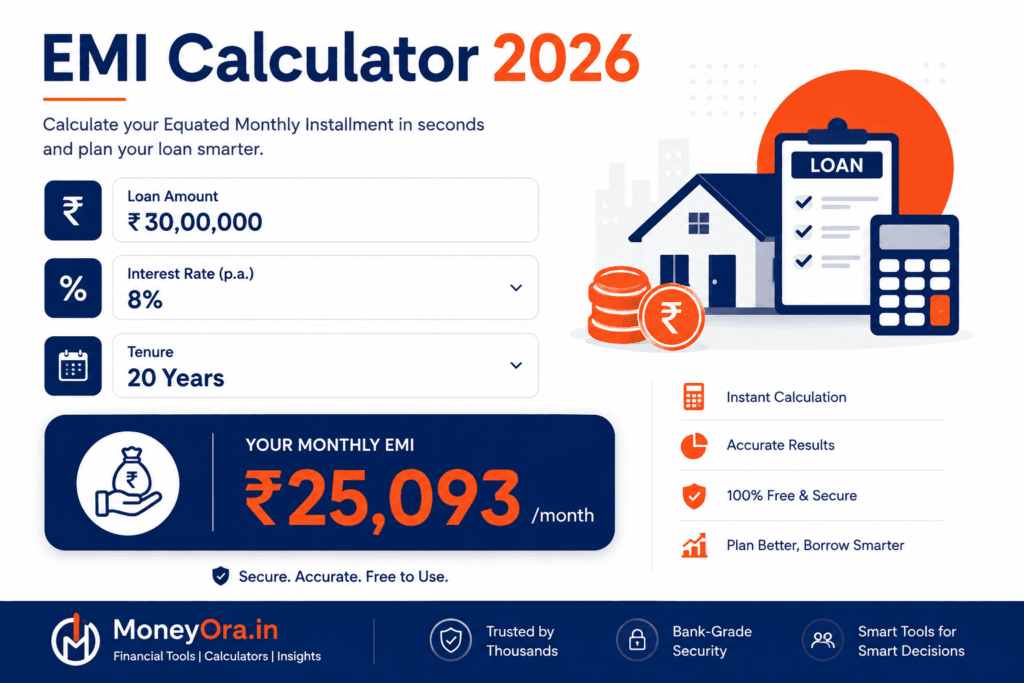
For a ₹30,00,000 home loan at 8% annual interest over 20 years (240 months), the EMI comes out to approximately ₹25,093 per month. Over the full tenure, you’d pay roughly ₹60,22,320 in total meaning about ₹30,22,320 goes purely toward interest.
That’s the part most people underestimate. On a 20-year loan, you often repay close to double the amount you borrowed. This isn’t a hidden fee it’s simply how compound interest works over a long tenure. Seeing the number clearly is the first step to managing it.
How the RBI Repo Rate Affects Your EMI in 2026
Your home loan EMI isn’t set once and forgotten for the vast majority of Indian borrowers, it’s tied to the RBI’s repo rate through a benchmark called EBLR (External Benchmark Lending Rate) or the older MCLR (Marginal Cost of Funds based Lending Rate) system.
| Benchmark | Reset Frequency | Who Uses It |
|---|---|---|
| EBLR (Repo-linked) | Every 1-3 months | Most new home loans since 2019 |
| RLLR (Repo Linked Lending Rate) | Every 1-3 months | Public sector banks |
| MCLR | Once every 6-12 months (loan anniversary) | Older loans, some private banks |
Here’s why this matters right now. The RBI delivered a cumulative 125 basis point rate cut through 2025 from 6.50% down to 5.25% the most aggressive easing cycle since 2019. The rate has held steady at 5.25% through the RBI’s April and June 2026 policy reviews, with the Monetary Policy Committee maintaining a neutral stance.
If you’re on an EBLR-linked loan, this cut should have already reduced your EMI or shortened your tenure automatically. If you’re on MCLR and your loan resets only once a year, you may still be paying the old, higher rate.
Are You Overpaying Right Now?
For a ₹50 lakh, 20-year home loan, the full 125 bps rate reduction (from 6.50% to 5.25%) translates to an EMI saving of approximately ₹3,050 per month or roughly ₹36,600 a year. Over a 20-year tenure, that compounds into lakhs of rupees in potential savings.
Here’s the check to run today: pull out your latest loan statement, note the interest rate mentioned, and compare it against your bank’s currently published EBLR or RLLR rate. If there’s a gap larger than 25-30 basis points and you’re not sure why, call your lender and ask directly, or consider a home loan balance transfer to a lender offering the current market rate.
A falling repo rate doesn’t guarantee your EMI actually drops some borrowers see their tenure extended instead of their EMI amount reduced, depending on how their bank structures the reset. Always confirm with your lender which adjustment method applies to your loan.
EMI Calculation for Different Loan Types
1. Home Loan EMI
Home loans typically run 15-30 years, making them the most interest-heavy loan type in absolute terms. As of June 2026, home loan interest rates in India start around 7.10% p.a. for borrowers with a CIBIL score of 750+ at select public sector banks, with most borrowers falling in the 7.65%-8.50% p.a. range depending on credit profile, income, and lender.
| Loan Amount | Interest Rate | Tenure | Approx. EMI | Total Interest Paid |
|---|---|---|---|---|
| ₹30,00,000 | 8.0% | 20 years | ₹25,093 | ₹30,22,320 |
| ₹50,00,000 | 7.8% | 20 years | ₹41,202 | ₹48,88,480 |
| ₹75,00,000 | 8.25% | 25 years | ₹58,780 | ₹1,00,34,000 |
Try your own numbers on MoneyOra’s Home Loan EMI Calculator — it also lets you model prepayments to see how much interest you can save by paying extra toward the principal.
2. Car Loan EMI
Car loans are shorter (typically 3-7 years) and carry slightly higher interest rates than home loans since vehicles depreciate fast and offer weaker collateral value. A ₹8,00,000 car loan at 9% for 5 years works out to an EMI of roughly ₹16,605, with total interest of about ₹1,96,300.
Use the dedicated Car Loan EMI Calculator to check exact numbers for your vehicle purchase.
3. Personal Loan EMI
Personal loans are unsecured, so they carry the highest interest rates of the three often 10.5% to 24% depending on your credit score and lender. A ₹3,00,000 personal loan at 13% for 3 years results in an EMI of approximately ₹10,110, with total interest of roughly ₹63,960 nearly 21% of the loan amount, in just three years.
Check exact figures using the Personal Loan EMI Calculator before committing to any lender’s offer.
Real Example – ₹5 Lakh Loan, Calculated
Rahul is a software engineer in Pune. He wants a ₹5,00,000 personal loan from ICICI Bank for his wedding. Before walking into the branch, he runs the numbers.
His loan details:
| Parameter | Value |
|---|---|
| Loan Amount | ₹5,00,000 |
| Interest Rate | 13% per annum |
| Tenure | 3 Years (36 months) |
The math:
- R = 13 ÷ 12 ÷ 100 = 0.01083
- EMI comes out to ₹16,861/month
What he’ll actually pay:
| Amount | |
|---|---|
| Monthly EMI × 36 | ₹6,06,996 |
| Total Interest | ₹1,06,996 |
| Original Principal | ₹5,00,000 |
Over a lakh in interest on a ₹5 lakh loan over 3 years. That’s the real cost of borrowing, and it’s not hidden it’s just rarely surfaced before you sign.
Rahul earns ₹60,000/month. His EMI of ₹16,861 is 28% of take-home pay within the safe 30-35% range most advisors recommend. Loan approved, finances intact.
He knew all of this before entering the bank.
EMI Amortization Table
Here’s how Rahul’s ₹5,00,000 loan at 13% breaks down month by month:
| Month | EMI (₹) | Interest Paid (₹) | Principal Paid (₹) | Balance (₹) |
|---|---|---|---|---|
| 1 | 16,861 | 5,417 | 11,444 | 4,88,556 |
| 6 | 16,861 | 4,813 | 12,048 | 4,33,028 |
| 12 | 16,861 | 4,143 | 12,718 | 3,69,834 |
| 18 | 16,861 | 3,428 | 13,433 | 3,00,862 |
| 24 | 16,861 | 2,662 | 14,199 | 2,25,485 |
| 30 | 16,861 | 1,843 | 15,018 | 1,42,981 |
| 36 | 16,861 | 182 | 16,679 | 0 |
Month 1: ₹5,417 in interest, ₹11,444 toward principal. By Month 36, it flips entirely. That’s amortization and it’s why the first few years of any loan are the most expensive, even when the EMI feels manageable.
Moneyora’s loan repayment calculator generates this full table for any loan, instantly.
Why Your EMI’s Interest-to-Principal Ratio Changes Every Month
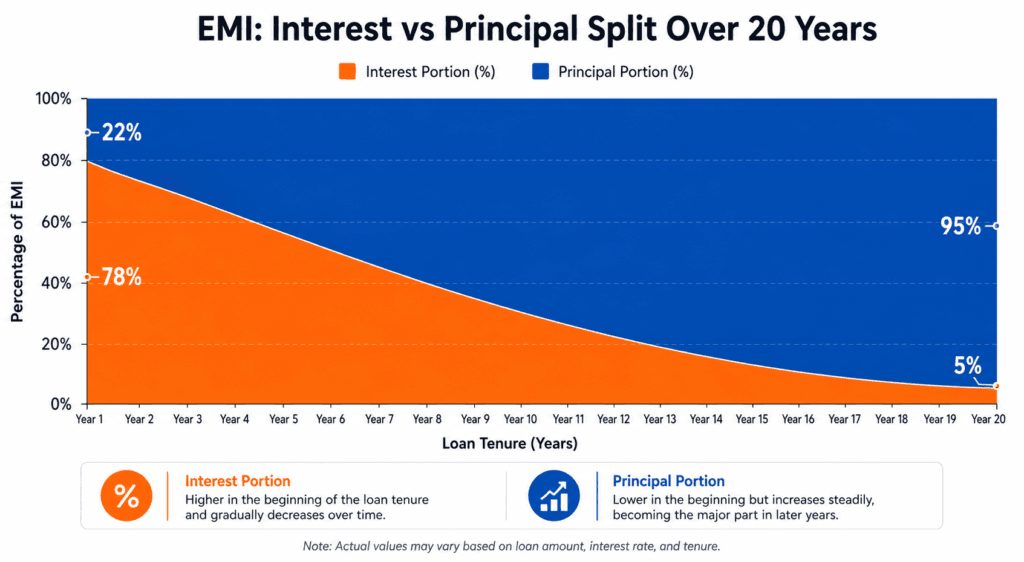
This is the part almost no borrower is told clearly at the time of taking a loan: in the early years, most of your EMI goes toward interest, not principal.
Here’s why. Interest is calculated on your outstanding principal balance each month. In year one, your outstanding balance is close to the full loan amount, so the interest component is large. As you keep paying, the outstanding balance shrinks, and a growing share of each EMI shifts toward principal repayment.
| Loan Year | Approx. Interest Portion of EMI | Approx. Principal Portion of EMI |
|---|---|---|
| Year 1 | 78% | 22% |
| Year 5 | 68% | 32% |
| Year 10 | 50% | 50% |
| Year 15 | 28% | 72% |
| Year 20 | 5% | 95% |
Illustrative split for a 20-year home loan at ~8% interest. Actual figures depend on your specific loan terms.
Bank Interest Rate Comparison 2026
Rates as of early 2026. Always confirm directly with the bank before applying — rates change.
| Bank | Personal Loan | Home Loan | Car Loan | Processing Fee |
|---|---|---|---|---|
| SBI | 11.15% -14.30% | 8.50% -9.65% | 8.75% -9.75% | 0 -1% |
| HDFC Bank | 10.85% -21.00% | 8.75% -9.65% | 9.00% -10.50% | Up to 2.50% |
| ICICI Bank | 10.85% -19.00% | 8.75% -9.80% | 9.00% -10.75% | Up to 2% |
| Axis Bank | 11.25% -22.00% | 8.75% -9.65% | 9.25% -10.50% | Up to 2% |
| Kotak Mahindra | 10.99% -24.00% | 8.75% -9.60% | 7.70% -12.00% | Up to 3% |
| Bank of Baroda | 10.90% -18.25% | 8.40% -9.65% | 8.70% -10.50% | 0.25% -1% |
A 1% lower rate on a ₹20 lakh home loan over 20 years saves over ₹2.5 lakh in total interest. That’s a number worth spending 10 minutes comparing.
Use these for quick comparisons:
7 Practical Ways to Reduce Your EMI
1. Improve Your CIBIL Score Before Applying
Lenders reserve their lowest advertised rates for borrowers with a CIBIL score of 750 and above. Even a 50-point improvement in your score can shift you into a better rate slab, directly lowering your EMI for the entire tenure.
2. Choose a Repo-Linked (EBLR) Loan Over MCLR
Since 2019, most new floating-rate loans are repo-linked, meaning they reset within 1-3 months of an RBI rate change. If you’re still on an older MCLR loan, you’re likely reacting to rate cuts a full year late.
3. Make a Larger Down Payment
A higher down payment directly reduces your principal (P) and since P sits at the front of the EMI formula, even a modest increase in down payment produces a noticeable EMI reduction.
4. Negotiate or Do a Balance Transfer
If your existing lender won’t match current market rates, a home loan balance transfer to another bank offering a lower rate can meaningfully cut your EMI but factor in processing fees and transfer charges before switching.
5. Make Regular Prepayments
Even small, periodic prepayments toward principal especially in the first 5 years reduce the outstanding balance that future interest is calculated on, shrinking either your EMI or your remaining tenure.
6. Choose Tenure Carefully Don’t Default to the Longest Option
Banks often present the longest tenure by default because it lowers the advertised EMI. But a longer tenure sharply increases total interest paid. Choose the shortest tenure your monthly budget can comfortably support.
7. Time Your Loan Around RBI Policy Cycles
If the RBI is in a rate-cutting cycle as it was through 2025 locking in a floating, repo-linked loan lets you benefit automatically from future cuts. In a rate-hiking cycle, some borrowers prefer fixed rates for predictability. Track RBI Monetary Policy Committee announcements before finalizing your loan.
What Most EMI Calculator Pages Don’t Tell You
Most EMI calculator pages online stop at “enter three numbers, get your EMI.” That’s useful, but incomplete. Here are three things that genuinely change how you should use the number.
1. The Same EMI Calculator Formula Doesn’t Mean the Same Real Cost
Two loans can show an identical EMI on a calculator and still cost you very differently in total interest because of processing fees, prepayment penalties, and whether interest is calculated on a reducing or flat basis. Always ask your lender to confirm the amortization method (almost all Indian banks use reducing balance, but always verify) before comparing EMIs across lenders.
2. EBLR vs MCLR Isn’t Mentioned on Most Calculator Pages But It Should Decide Your Rate Choice
Very few EMI calculator guides explain that your benchmark type (EBLR/RLLR vs MCLR) determines how fast RBI rate changes actually reach your EMI. This single detail can be worth thousands of rupees a year in a falling-rate environment like 2025-26.
3. A Lower EMI Isn’t Always the Better Deal
Extending tenure to reduce monthly EMI feels like relief but the total interest cost can rise dramatically. Before accepting a “lower EMI” offer from a lender, always check the total interest payable figure side by side, not just the monthly number.
Risks and Mistakes to Avoid With EMI Planning
Tax Benefits on Loan EMIs
Home Loan
- Section 24(b): Up to ₹2,00,000 deduction on interest paid per year for self-occupied property
- Section 80C: Up to ₹1,50,000 deduction on principal repayment per year
- Section 80EEA: Additional ₹1,50,000 interest deduction for first-time buyers in affordable housing
Education Loan
- Section 80E: Full interest deduction for up to 8 years, with no upper limit. Most people don’t claim this. Virtually nobody who’s eligible should miss it.
Personal and Car Loans
No tax benefit for personal expenses. If the loan funds a business purpose, the interest is deductible as a business expense but document it properly.
For your specific situation, check the Income Tax Department’s guidance on Section 80C and Section 24 or talk to a CA.
Calculate Your Exact EMI in Seconds
Reading about the formula is useful for understanding the mechanics but for your actual loan decision, you need precise numbers based on your specific principal, rate, and tenure.
MoneyOra’s free EMI Calculator gives you instant results along with a full amortization breakdown. If you’re specifically evaluating a home purchase, the Home Loan EMI Calculator also lets you factor in prepayments. For vehicle financing, use the Car Loan EMI Calculator, and for unsecured borrowing, the Personal Loan EMI Calculator.
You should also check your affordability against your total obligations using the Mortgage Calculator, and if you’re comparing loan providers, use MoneyOra’s IFSC Code Finder and Bank Details Finder to confirm lender information before initiating any transfer.
Use the free EMI Calculator, Home Loan EMI Calculator, and Mortgage Calculator on MoneyOra.in all free, no login required.
Use the free calculator now on MoneyOra.in
Use the EMI Calculator Before You Borrow, Not After
An EMI calculator isn’t just a convenience used correctly, it’s a decision-making tool. It tells you not just what you’ll pay monthly, but how much of that payment is truly interest, how tenure choices trade off against total cost, and whether your current loan still matches today’s RBI repo rate environment.
With the RBI holding rates at 5.25% after an aggressive 2025 cutting cycle, this is a good moment to run your existing loan numbers again not just new ones. Check your benchmark type, compare your effective rate to what’s currently on offer, and use prepayment modeling if you have surplus funds sitting idle.
- Use the MoneyOra EMI Calculator to get your exact monthly payment and amortization schedule.
- Check whether your loan is EBLR/RLLR-linked or MCLR-linked using your loan sanction letter.
- Compare your current effective interest rate against your bank’s currently published rate.
- Model prepayment scenarios using the Home Loan EMI Calculator if you have surplus funds.
- Consult your bank or a certified financial advisor before making a balance transfer or prepayment decision.
MoneyOra’s free calculators help you compare EMIs, model prepayments, and make confident borrowing decisions.
Use the free calculator now on MoneyOra.in
Research Sources Used
- Reserve Bank of India (RBI) — Monetary Policy Committee repo rate decisions
- State Bank of India — Home loan interest rate reference
- Industry reports on EBLR/RLLR/MCLR lending benchmarks (BankBazaar, Business Today, April 2026)
- Standard EMI amortization methodology (reducing balance method), as used across Indian banks and NBFCs
EMI Calculator
What is the formula to calculate EMI manually?
The standard EMI formula is EMI = [P × R × (1+R)^N] / [(1+R)^N − 1], where P is the loan principal, R is the monthly interest rate (annual rate divided by 12 and by 100), and N is the total number of monthly installments. For example, a ₹30,00,000 loan at 8% annual interest over 240 months (20 years) works out to an EMI of approximately ₹25,093. Most people use an online EMI calculator instead of manual calculation to avoid compounding errors.
What is the current RBI repo rate in 2026 and how does it affect my EMI?
The RBI repo rate stood at 5.25% as of June 2026, unchanged since December 2025, following a cumulative 125 basis point cut through 2025. If your home loan is linked to EBLR or RLLR, this rate directly affects your EMI, usually resetting within 1-3 months of any RBI policy change. MCLR-linked loans reset only once a year, so the benefit reaches you more slowly.
Does a lower EMI always mean a cheaper loan?
No. A lower EMI is often achieved by extending the loan tenure, which increases the total interest paid over the life of the loan. Always compare the total interest payable not just the monthly EMI figure before choosing between two loan offers or tenure options. A shorter tenure with a slightly higher EMI is usually cheaper overall.
Why does most of my EMI go toward interest in the early years?
Interest is calculated each month on your outstanding loan balance, which is highest at the start of the loan. In year one of a typical 20-year home loan, roughly 78% of your EMI goes toward interest and only about 22% reduces the principal. As the outstanding balance shrinks over time, the principal portion of each EMI grows steadily.
What is the difference between EBLR and MCLR for EMI calculation?
EBLR (External Benchmark Lending Rate) and RLLR (Repo Linked Lending Rate) are directly tied to the RBI repo rate and reset within 1-3 months of a rate change. MCLR (Marginal Cost of Funds based Lending Rate) resets only once a year, on your loan’s anniversary date. In a falling-rate environment like 2025-26, EBLR/RLLR borrowers receive EMI relief faster than MCLR borrowers.
How much can I save by prepaying my home loan early?
Prepayment savings depend on when you prepay. Because interest is front-loaded in the early years of a loan, prepaying principal in year 2 or 3 saves significantly more total interest than prepaying the same amount in year 15, since you avoid many more years of interest accrual on that portion. Use an EMI calculator with a prepayment feature to model your specific numbers before deciding.
Can my EMI increase even on a floating rate loan?
Yes. Floating rates move in both directions with the RBI repo rate. While rates fell 125 basis points through 2025, floating-rate borrowers should budget with some buffer in case the RBI raises rates again in a future policy cycle. It is a common mistake to assume floating rates only decline over time.
Are EMI calculators the same for home, car, and personal loans?
The underlying EMI formula is identical across loan types it only needs principal, interest rate, and tenure. However, dedicated calculators for home, car, and personal loans often include loan-specific features, such as prepayment modeling for home loans or eligibility caps based on loan type, making it easier to plan for that specific borrowing scenario.
FAQ — Questions People Actually Ask
The EMI formula is:
EMI = [P × R × (1+R)^N] / [(1+R)^N – 1].
P is the loan principal.
R is the monthly interest rate.
This is calculated as annual rate ÷ 12 ÷ 100.
N is the tenure in months.
You don’t need to calculate this manually.
MoneyOra's EMI calculator gives instant results.
It also shows the full amortization breakdown.
At 2% per month (24% annually) for ₹2,00,000.
For 12 months, EMI is around ₹18,871/month.
Total interest is roughly ₹26,452.
This is a very high interest rate.
It is common in informal lending.
It is not typical for regulated banks.
Compare rates using the personal loan EMI calculator.
Fastest options in India include personal loan apps.
Apps like KreditBee, MoneyTap, and PaySense disburse quickly.
A credit card cash advance is instant.
However, it comes with high interest.
A salary advance from your employer has no interest.
A gold loan is another fast option.
Banks like SBI or lenders like Muthoot Finance process it quickly.
Before choosing, check repayment using the EMI calculator.
Yes, it is accurate.
MoneyOra's EMI calculator uses the standard formula.
This is the same formula used by banks and NBFCs.
The results match official amortization schedules.
It is completely free to use.
No account is required.
You can verify results with your bank’s loan offer letter.
At 13% for 3 years, EMI is ₹16,861/month.
At 12% for 5 years, EMI is ₹11,122/month.
Lower EMI means longer tenure.
Longer tenure increases total interest.
Use the EMI Calculator India to compare options.
The EMI is ₹26,035/month.
Total interest is around ₹32.5 lakh.
This is higher than the loan amount.
This is normal for long-tenure loans.
Compare different tenures before choosing.
Use the Home Loan EMI Calculator.
Financial planners recommend 30–35%.
This is based on your net monthly income.
Banks may approve up to 50%.
But higher EMI can be risky.
Lower ratios allow savings and emergency funds.
You will be charged a late payment fee.
This is usually ₹500–₹1,000 or more.
Your CIBIL score will be affected.
It may drop by 50–100 points.
Interest continues to accumulate.
Repeated defaults may lead to legal action.
Set up auto-debit to avoid this risk.
For fixed-rate loans, EMI does not change.
It stays constant throughout the tenure.
For floating-rate loans, EMI may change.
This happens when RBI repo rate changes.
Some banks adjust tenure instead of EMI.
Always check your loan agreement.
Yes, most banks allow prepayment.
There may be a penalty on fixed-rate loans.
This is usually 2–4% of outstanding amount.
Floating-rate home loans have no penalty.
This is as per RBI rules.
Always calculate savings before prepaying.