
Rs 1 Lakh Monthly Income After Retirement 2026: The Exact Portfolio Plan
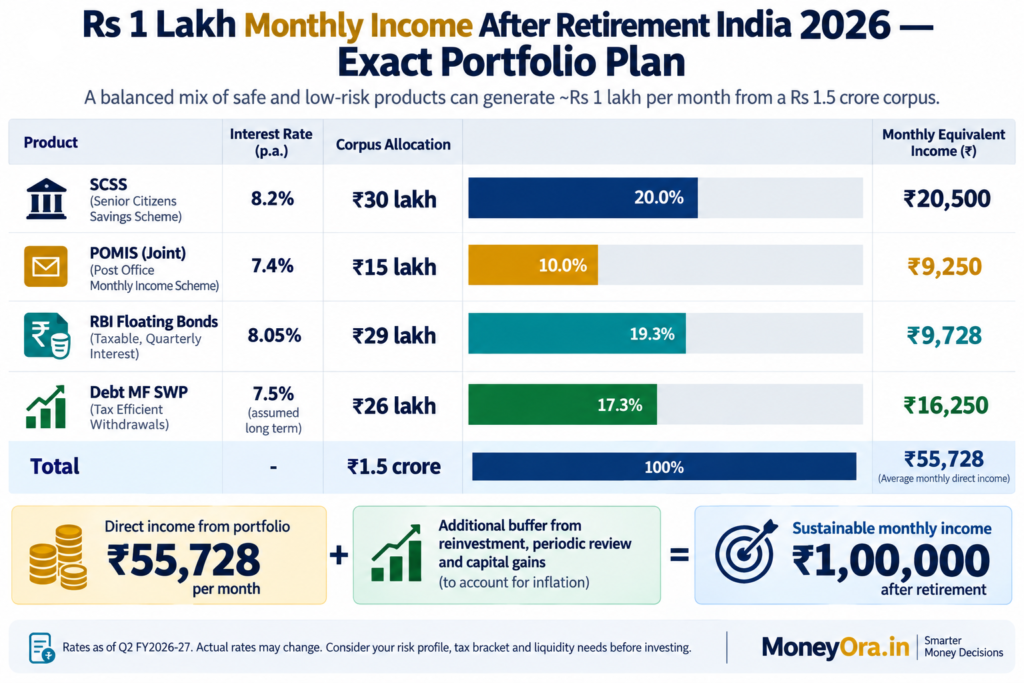
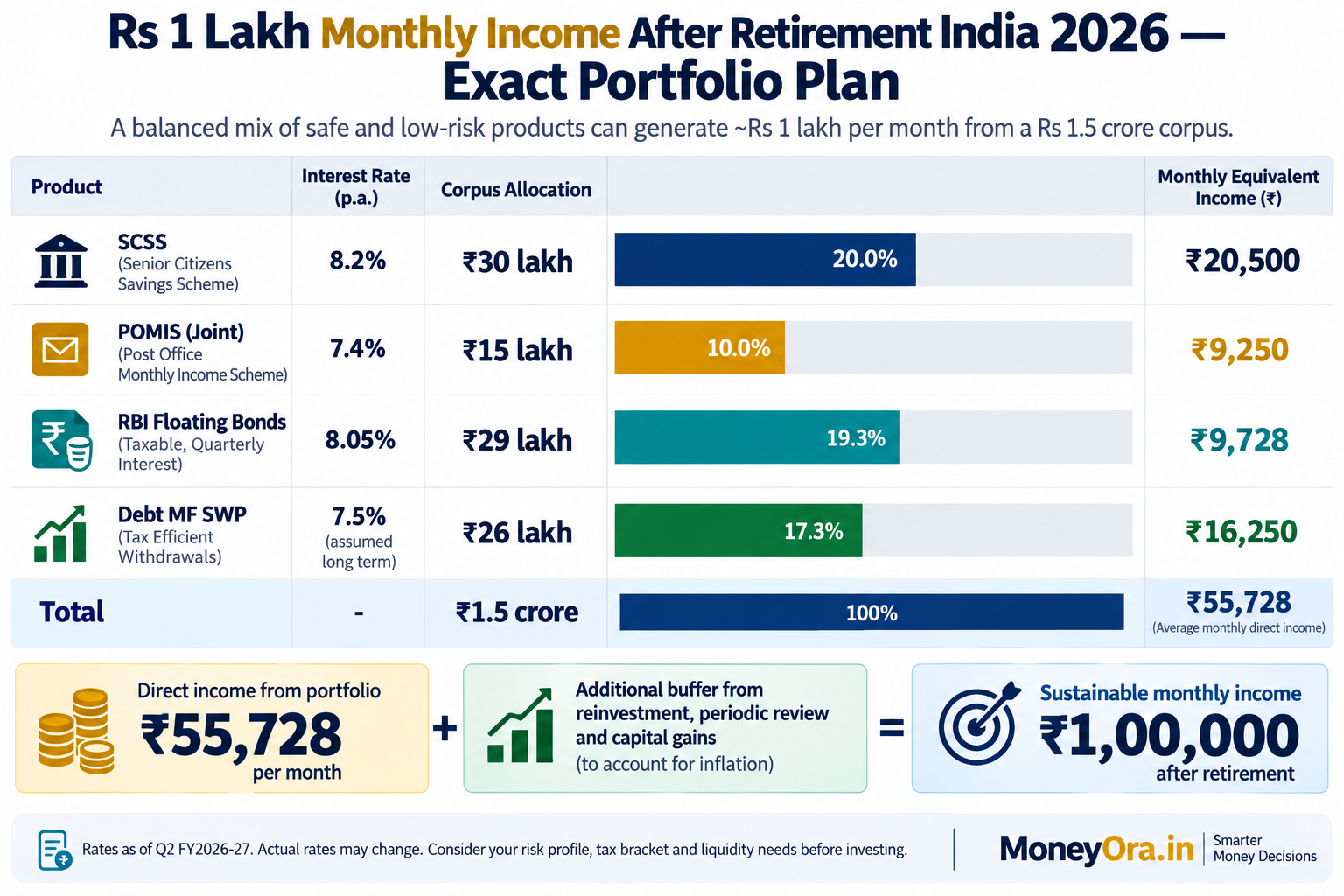
- Rs 1 lakh monthly income after retirement India 2026 requires a corpus of approximately Rs 1.5 crore using the 5-product portfolio in this guide.
- SCSS pays 8.2% pa (locked for 5 years) quarterly with a Rs 30 lakh cap per individual.
- POMIS pays 7.4% pa monthly with Rs 9 lakh single account and Rs 15 lakh joint account cap.
- RBI Floating Rate Bonds pay 8.05% pa semi-annually with no investment cap.
- Debt MF SWP provides monthly cash flow with indexation benefit that reduces effective tax on large amounts.
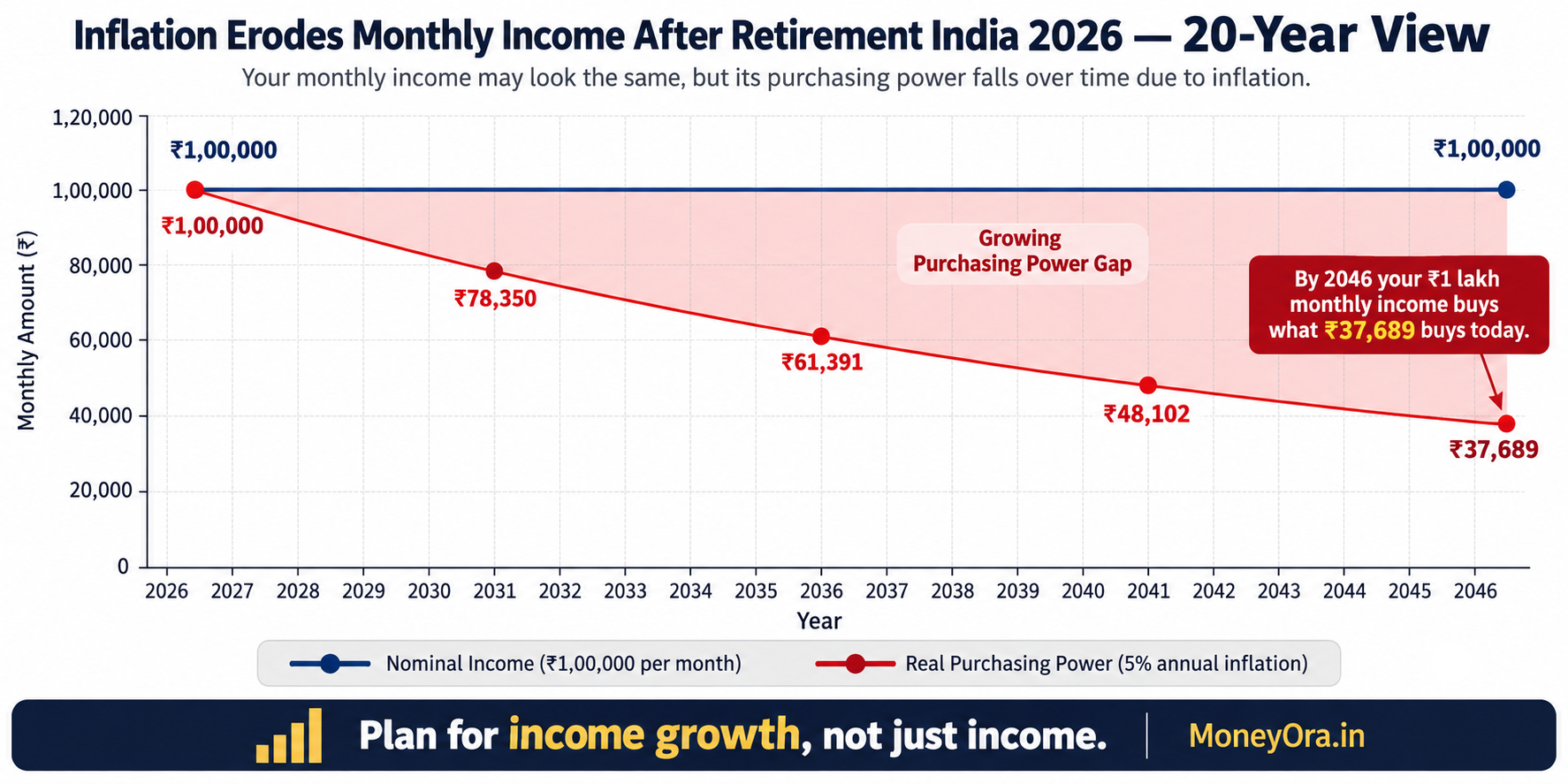
- Rs 1 lakh in 2026 buys what Rs 72,000 bought in 2016 at 3.3% inflation. Plan for income growth not just income.
- For a married couple using joint accounts, Rs 1 lakh monthly income from retirement savings is achievable from a smaller corpus.
Most retirement planning articles in India give you a list of products. SCSS, POMIS, RBI Bonds, Debt Mutual Funds. Then they stop. They never show you the actual numbers. Which product gets how much of your corpus. What arrives in your account each month. What the tax eats. What happens after 5 years when SCSS matures.
This article does the calculation. Completely. For a Rs 1.5 crore corpus targeting Rs 1 lakh monthly income after retirement India 2026. Then for a Rs 75 lakh corpus targeting Rs 50,000 per month, because that is what the majority of Indian retirees actually have from EPF, gratuity, and savings. Both plans use current rates, verified for Q2 FY 2026-27.
The Current Rate Card for Monthly Income After Retirement India 2026
Before the allocation table I list the verified rates for each product in this plan. All figures are confirmed for Q2 FY 2026-27 which covers July to September 2026.
SCSS which stands for Senior Citizen Savings Scheme offers an interest rate of 8.2% per year. This rate has not changed for than three years and is the highest among all small savings plans sharing the top spot only with Sukanya Samriddhi Yojana. SCSS pays interest every quarter. You can invest up to Rs 30 lakh per person. The plan locks in your money for five years. You may extend it for another three years if you wish.
POMIS, short for Post Office Monthly Income Scheme gives a return of 7.4% that is paid every month. The maximum amount you can put in an account is Rs 9 lakh and for a joint account of two or three adults it is Rs 15 lakh. The scheme lasts five years. You cannot extend it once it ends.
RBI Floating Rate Savings Bonds 2020 which are taxable offer a return of 8.05% for the time from July to December 2026. This rate follows the National Savings Certificate rate plus a margin of 35 basis points. You receive interest twice a year on January 1 and July 1. There is no cap on how much you can invest. The bonds have a term but senior citizens can leave early after a shorter lock‑in period that depends on their age.
Debt Mutual Fund SWP expects a 7.5% return each year from a short‑duration or corporate bond fund. When you take withdrawals they are considered partial redemptions. After three years the indexation benefit on long‑term capital gains cuts the tax you pay a lot. You do not have to pay TDS on these withdrawals. You can change how much you withdraw each month whenever you want.
Liquid Fund Buffer is not meant to give you income. It keeps money to cover three months of expenses so you do not have to touch your locked‑in investments when cash flow gaps occur.
The Exact Rs 1.5 Crore Allocation for Rs 1 Lakh Per Month
Every product in this retirement income plan has a different payout frequency. SCSS pays quarterly. POMIS pays monthly. RBI Bonds pay twice a year. Debt MF SWP pays whenever you set the trigger. To deliver a smooth Rs 1 lakh every month, you need to understand what each product delivers and when.
Here is the complete allocation table. No competitor article has published this calculation.
| Product | Corpus Allocated | Rate | Annual Income | Payout Frequency | Monthly Equivalent |
|---|---|---|---|---|---|
| SCSS | Rs 30,00,000 | 8.2% | Rs 2,46,000 | Quarterly (Rs 61,500 per quarter) | Rs 20,500 |
| POMIS (Joint) | Rs 15,00,000 | 7.4% | Rs 1,11,000 | Monthly (Rs 9,250 per month) | Rs 9,250 |
| RBI Floating Bonds | Rs 29,00,000 | 8.05% | Rs 2,33,450 | Semi-annual (Rs 1,16,725 on Jan 1 and Jul 1) | Rs 9,728 |
| Debt MF SWP | Rs 26,00,000 | 7.5% | Rs 1,95,000 | Monthly (Rs 16,250 SWP set) | Rs 16,250 |
| Liquid Buffer | Rs 50,000 | ~6.5% | Rs 3,250 | On demand | Buffer only |
| TOTAL | Rs 1,50,50,000 | 7.84% avg | Rs 7,88,700 | Mixed | Rs 55,728 direct monthly |
Wait The direct monthly cash flow adds up to only Rs 55,728 per month (POMIS Rs 9,250 plus Debt MF SWP Rs 16,250 plus the liquid buffer). The SCSS and RBI Bond income arrives on different schedules. This is the income smoothing problem and it is the part most articles skip entirely.
The Income Smoothing Calendar: Getting Rs 1 Lakh Every Month
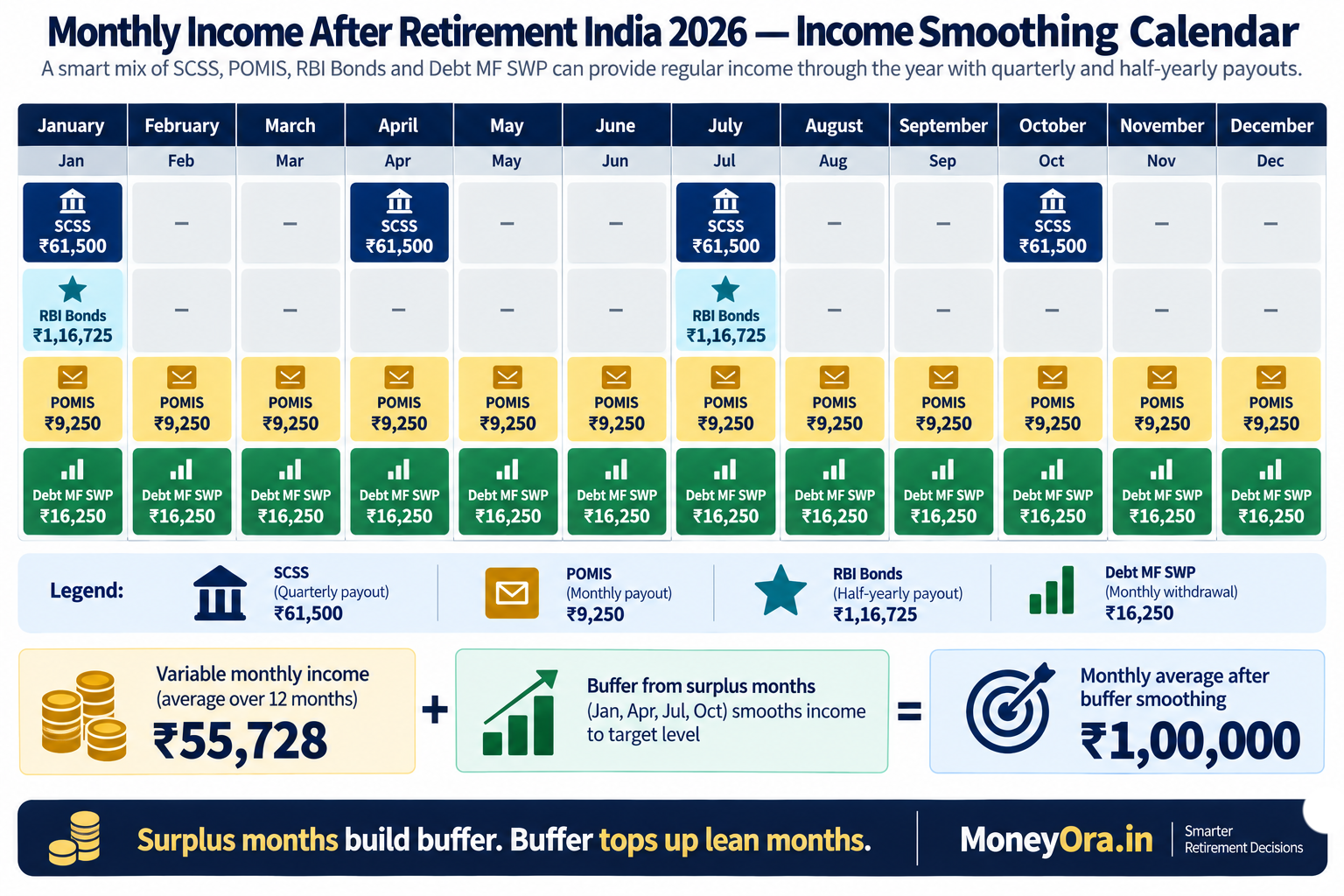
Monthly income after retirement India 2026 works only if you actively manage the cash flow calendar. Here is the month-by-month picture of what arrives and when.
In the Income Smoothing Calendar January and July bring a payday of Rs 1,16,725 from RBI Bonds. That is a lump sum that comes twice a year. In April July, October and January SCSS pays Rs 61,500. POMIS delivers Rs 9,250 every month on time. Your Debt MF SWP pays whatever amount you choose every month.
The smoothing strategy works like this. The Debt MF SWP is not set at Rs 16,250. It is set at Rs 55,000. POMIS adds Rs 9,250 bringing the base flow to Rs 64,250. On SCSS quarters (January, April, July, October) you receive Rs 61,500 extra. On RBI Bond months (January and July) you receive Rs 1,16,725 extra. These surplus months feed the buffer. The buffer then tops up the months.
run a savings account labelled as your income buffer. On the months you receive payouts park the surplus above Rs 1 lakh into this buffer. In the months, with no SCSS or RBI payment draw from the buffer. The Debt MF SWP is the workhorse providing most of the base income because it is the only product where you fully control the monthly amount and can adjust it up or down anytime.
The Income Smoothing Calendar shows that this cash flow management approach is what makes the plan actually work in practice versus on paper.
The Post-Tax Reality: What You Keep After Income Tax
Every product in this plan generates income except the capital gain component of the Debt MF SWP after 3 years, which benefits from indexation.
SCSS interest is fully taxable at your slab rate. At Rs 2,46,000 per year a retiree in the 20% tax bracket pays Rs 49,200 in tax on SCSS. A retiree in the 30% bracket pays Rs 73,800. For FY 2026-27 senior citizens have a TDS threshold of Rs 1 lakh on interest income from banks and post offices. Submit Form 15H if your total income is below the limit to avoid TDS deductions.
POMIS interest of Rs 1,11,000 per year from the account is also fully taxable at slab. No TDS is deducted on POMIS by the post office regardless of amount. The income must be reported in your ITR.
RBI Bond interest of Rs 2,33,450 per year is fully taxable. No exemption applies. The name of the bond itself says FRSB 2020 Taxable). This income is added to your total and taxed at your applicable rate.
Debt MF SWP is where the tax calculation gets interesting and where this plan has an advantage over putting everything in FDs or small savings schemes. Each monthly SWP redemption is treated as a withdrawal of units. The redemption has two components. One is return of capital. The other is gain. For units held longer than 3 years the gain qualifies as long-term capital gain with indexation benefit. Indexation adjusts the cost of acquisition upward for inflation using the governments Cost Inflation Index reducing the gain significantly.
In terms: Rs 26 lakh invested in a debt fund earning 7.5% pa. After 3 years if inflation averaged 5% the indexed cost of Rs 26 lakh becomes Rs 30 lakh using cost inflation index. The taxable gain on each SWP unit is reduced considerably. For a retiree in the 20% bracket this translates to a lower effective tax on the Debt MF income compared to the same amount, in an FD taxed at 20% on the full interest.
If you want to model how tax you will pay at different income levels our income tax calculator lets you input all income sources including interest and capital gains to get your precise liability.
The Smaller Plan: Rs 50,000 Monthly Income from Rs 75 Lakh Corpus
Not everyone retires with Rs 1.5 crore The majority of Indian retirees collect between Rs 50 lakh and Rs 1 crore from EPF, gratuity and savings. Here is the monthly income after retirement India 2026 plan scaled to Rs 75 lakh corpus targeting Rs 50,000 per month.
| Product | Corpus Allocated | Rate | Monthly Equivalent |
|---|---|---|---|
| SCSS | Rs 15,00,000 | 8.2% | Rs 10,250 |
| POMIS (Joint) | Rs 15,00,000 | 7.4% | Rs 9,250 |
| RBI Floating Bonds | Rs 20,00,000 | 8.05% | Rs 13,417 |
| Debt MF SWP | Rs 24,00,000 | 7.5% | Rs 15,000 |
| Liquid Buffer | Rs 1,00,000 | ~6.5% | Buffer only |
| TOTAL | Rs 75,00,000 | 7.67% avg | Rs 47,917 avg monthly |
The Rs 47,917 average is a genuine Rs 50,000 per month when the income smoothing calendar is applied. The Debt MF SWP is set at Rs 25,000 rather than Rs 15,000 in months when SCSS and RBI Bond income does not arrive, pulling the average up. SCSS quarters and RBI Bond semi-annual payments refill the buffer.
To model how your EPF corpus or lump sum retirement payout could be deployed across these products and what return you would earn, use our SIP calculator for the mutual fund SWP portion and our FD calculator to compare fixed deposit alternatives.
The Joint Account Advantage: A Married Couple’s Version
Every article on monthly income after retirement India 2026 ignores the joint account version. This is a significant gap because the numbers change considerably for a married couple.
Under current rules, SCSS allows Rs 30 lakh per individual. A husband and wife can each invest Rs 30 lakh in SCSS individually putting Rs 60 lakh total in SCSS earning Rs 4,92,000 per year or Rs 41,000 per month combined. POMIS in a joint account (held by husband, wife and optionally a third adult) allows up to Rs 15 lakh, paying Rs 9,250 per month.
For a couple with a Rs 1.5 crore corpus, the joint account plan looks quite different. Rs 60 lakh in SCSS (Rs 30 lakh each) generates Rs 41,000 per month. Rs 15 lakh in joint POMIS generates Rs 9,250 per month. Rs 50 lakh in RBI Bonds generates Rs 33,542 per month in monthly-equivalent terms. Rs 24 lakh in Debt MF SWP generates Rs 15,000 per month via SWP. That adds to Rs 98,792 per month from Rs 1,49,00,000 with lower reliance on the least tax-efficient components.
The joint SCSS route also spreads the tax liability. Each spouse reports half the SCSS interest in their own ITR. If one spouse has lower other income their effective tax rate on the SCSS income may be lower reducing the household’s total tax bill on this component.
What Happens When SCSS and POMIS Mature After 5 Years
Both SCSS and POMIS have 5-year lock-ins. Most articles treat the products as if the 5-year period is the end of the story. It is not. What you do at maturity determines whether your retirement income continues smoothly or faces a disruption.
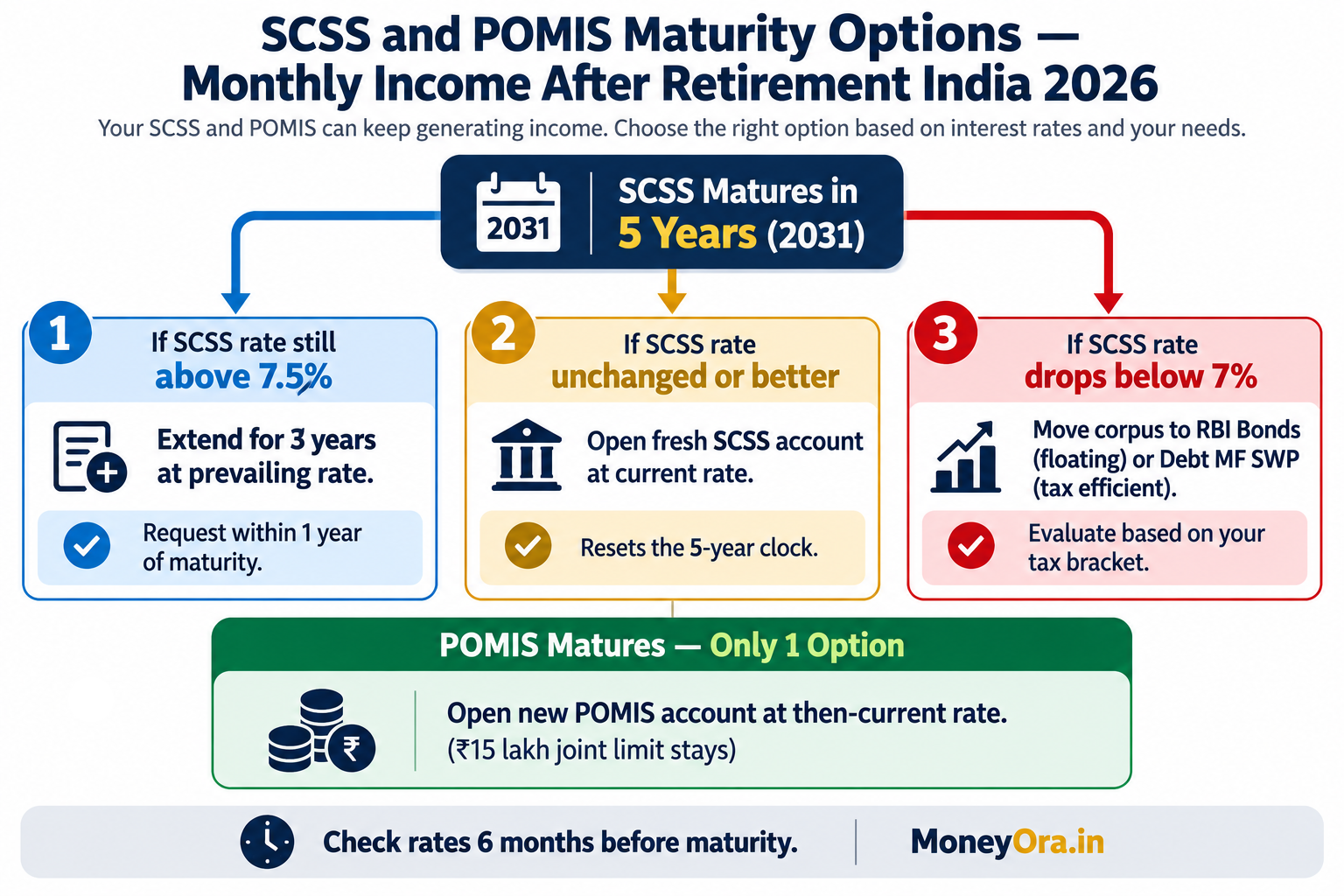
For SCSS you have options at the 5-year maturity date. First extend the account for 3 more years. The extension must be requested in writing within 1 year of the maturity date. The extended account earns the prevailing SCSS rate at the time of extension not the rate you originally locked in. If SCSS rates have dropped from 8.2% to 7.5% by 2031, your extension runs at 7.5%. Second withdraw the Rs 30 lakh and reinvest in a fresh SCSS account at whatever rate applies then. Third if SCSS rates have fallen significantly consider shifting this corpus into RBI Floating Rate Bonds (which are floating and will have adjusted up if rates elsewhere rose) or into Debt MF SWP for better post-tax efficiency.
For POMIS there is no extension option. After 5 years your Rs 15 lakh is returned. You must open a new POMIS account if you want to continue the scheme. The good news is the new account earns the current rate at reinvestment time. The limitation is the Rs 15 lakh joint cap stays the same. If you need more income at that point the excess goes into RBI Bonds or additional Debt MF SWP.
Planning this maturity reinvestment is something to do before the 5-year clock runs out. Mark your calendar 6 months before the SCSS maturity date to assess whether extension, fresh SCSS or a product switch makes the most sense based on then-prevailing rates.
The Inflation Danger No Competitor Article Warns
Rs 1 lakh per month sounds comfortable today It is important to understand that with India’s average consumer price inflation around 5% every year the value of Rs 1 lakh will drop over time. By 2036 Rs 1 lakh in 2026 will only have the buying power of Rs 61,000 By 2046 that same amount will be worth just Rs 38,000. A 25-year retirement with a fixed income at 5% inflation means your real income loses than half its value.
This is the inflation risk that every competitor article on monthly income after retirement India 2026 fails to mention. They show you how to get Rs 1 lakh per month None of them explain that keeping this amount flat for twenty years leaves you significantly poorer in real terms by the fifteenth year.
The only product in this portfolio that naturally grows to fight inflation is the Debt Mutual Fund SWP. Here’s why when you set up a Systematic Withdrawal Plan of Rs 16,250 per month from a corpus earning 7.5% you are not taking all the returns out. Roughly Rs 16,250 comes out each month. The rest of the earnings stay inside the fund. Over time the corpus grows. After five years the Debt MF corpus increases from Rs 26 lakh to Rs 28.5 lakh. This growth allows you to raise withdrawals without using up the principal fast.
The practical way to defend against inflation in this plan is to increase the Debt MF SWP by 3% to 4% every year. Start at Rs 16,250 in year one. Then go to Rs 16,900 in year two. By year five increase it to Rs 18,500. This growing withdrawal from an appreciating corpus slowly makes up for the erosion caused by inflation on fixed-income sources like SCSS, POMIS and RBI Bonds.
RBI Floating Rate Bonds also provide some protection against inflation. Their interest rate is linked to the NSC rate. If the government raises the NSC rate during periods of inflation the RBI Bond rate will also rise at the next reset. This is not as strong as equity-based inflation protection. It is better than the completely fixed rates of SCSS or POMIS.
Why Every Retiree Should Ask Their Advisor About SCSS Before Any Other Product
The sequence in which you deploy a retirement corpus matters. SCSS should be the first product funded for any retiree who qualifies (age 60 and above). Here is the logic.
At 8.2% guaranteed by the Government of India, locked in for 5 years regardless of rate changes, with quarterly payments directly to your savings account, SCSS is the highest-yielding sovereign instrument available to Indian retirees today. Nothing else offers this combination of rate, safety, and simplicity. With FD rates slipping after RBI rate cuts, the Senior Citizens Savings Scheme at 8.2% is one of the safest high fixed returns a retiree can lock in this quarter, government-backed and paying every three months with the rate held for five years.
Fund SCSS first. Max out the Rs 30 lakh individual limit as the anchor of your retirement income plan for India 2026. Then move to POMIS to add the monthly income stream. Then RBI Bonds for the large surplus that exceeds the SCSS and POMIS caps. Then Debt MF SWP for tax efficiency on the residual. The sequence is not arbitrary. It prioritises rate and safety first and adds complexity and tax planning only where the base instruments hit their limits.
One planning detail that many retirees miss. The SCSS account can be opened at both Post Offices and authorised banks (SBI, HDFC Bank, ICICI Bank, Axis Bank, and others). Opening at a bank rather than a post office means your quarterly interest credits come directly to your bank savings account automatically without any action on your part. For retirees who prefer one less thing to manage, this auto-credit feature at the bank branch is worth knowing about.
Questions People Ask About Monthly Income After Retirement in India Now
People looking for guidance on monthly income after retirement India for 2026 keep asking the same questions that no single article has answered in one place. This article covers all those questions. It is useful to state them directly because they show real gaps in the guidance that is currently available.
People ask if a corpus of Rs 50 lakh is enough for retirement in India. Today putting Rs 50 lakh into the mix of SCSS, POMIS and Debt MF SWP can produce about Rs 32,000 to Rs 34,000 per month before tax. For a retiree who does not pay rent does not pay school fees and lives a lifestyle this amount is enough if managed carefully. However it gives little protection against inflation, which is the main issue over a 20‑to‑25‑year retirement horizon.
People ask if it is safe to put all retirement money into SCSS and POMIS. In terms of credit risk SCSS and POMIS are safe because they are backed by the government. Yet three risks are often ignored. First both schemes lock money for five years. Changes in rates at maturity can lower income. Second the interest earned is fully taxable so a retiree in the 30 % tax bracket keeps 70 paise out of every rupee earned. Third neither SCSS nor POMIS grows with inflation so purchasing power falls over time. Adding RBI Bonds and Debt MF SWP to the mix can reduce all three problems to some extent.
People ask how the pension payout from NPS compares with this plan. When you retire from NPS you must buy an annuity with 40 % of the corpus. Annuity rates in India usually range from 5.5 % to 6.5 % depending on the choice. Those rates are lower than the rates offered by SCSS and POMIS. The remaining 60 % of the corpus can be invested as suggested in this plan. For example a retiree with an NPS corpus of Rs 1 crore would buy an annuity with Rs 40 lakh at 6 % which yields Rs 2,40,000 per year or Rs 20,000 per month. The Rs 60 lakh that is invested in the plan would provide a Rs 38,000 to Rs 40,000 per month. Together the retiree would receive close to Rs 60,000 per month from a Rs 1 crore NPS corpus.
Our NPS calculator can show what your NPS corpus will be at retirement and the monthly income it will provide when combined with this deployment plan.
People ask if they should invest in Senior Citizen Fixed Deposits of SCSS. Bank senior citizen fixed deposits now offer rates of 7.25 % to 7.75 % per year which’s lower than the SCSS rate of 8.2 %. The main differences are that fixed deposits have no investment limit unlike SCSS which limits to Rs 30 lakh. Fixed deposits from banks also carry higher credit risk than the government‑backed SCSS. Additionally tax deduction at source on fixed deposit interest applies when a senior citizen earns more than Rs 1 lakh per year. For the Rs 30 lakh of a retirement corpus SCSS is usually better. For amounts above Rs 30 lakh the choice, among fixed deposits RBI Bonds and Debt MF SWP depends on a retiree’s individual tax situation.
Building Your Personal Monthly Income After Retirement India 2026 Plan
The plans above are starting points, not templates to copy without thought. Your personal numbers will differ based on actual corpus other income sources, tax bracket and whether you are planning individually or as a couple.
Three questions determine your allocation. First how much of your corpus can go in SCSS? If you are 60 or above put the maximum Rs 30 lakh here first. Below 60, SCSS is not available and you will rely more on POMIS, RBI Bonds, and Debt MF SWP in the interim.
Second are you planning jointly? If you have a spouse the joint POMIS account raises the POMIS cap from Rs 9 lakh to Rs 15 lakh and the individual SCSS limits of Rs 30 lakh each give you Rs 60 lakh in SCSS combined. These are significant capacity increases that change the allocation meaningfully.
Third what is your tax bracket in retirement? If most of your income will be from government schemes and your total income stays below the Rs 3 lakh senior citizen basic exemption limit plus the Rs 50,000 standard deduction tax planning matters less and the simplicity of SCSS plus POMIS plus RBI Bonds may be sufficient. If your other income (rent, pension, other interest) already pushes you into the 20% or 30% bracket the Debt MF SWP becomes more important for its indexation-based tax efficiency.
If you need to project whether your current savings trajectory reaches the Rs 1.5 crore or Rs 75 lakh corpus targets our SIP calculator will show you exactly how much monthly investment at a given return builds to your target corpus by retirement. And our PPF calculator helps you model how a PPF account running through your working years contributes to that final number.
The One Number Every Retiree Needs to Calculate Before Anything
Before you choose any product before you decide on any investment mix there is one number that matters more than all the rest. It’s your expense number after taking out any guaranteed income like a pension or rental earnings. This is the amount your investment portfolio must produce every month.
For example if your monthly expenses are Rs 80,000 and you get Rs 20,000 every month from a government pension then your portfolio only needs to generate Rs 60,000. Not Rs 1 lakh. The plan in the example assumes a household needs the Rs 1 lakh from investments If your goal is different then the required corpus will change accordingly.
Rs 60,000 per month requires around Rs 90 lakh at rates. Rs 75,000 per month would need about Rs 1.12 crore. These numbers are estimates. They give a clear idea of what you might need.
Getting this target amount right is more important than picking the perfect investment allocation. A less ideal mix of assets may still work well if your corpus is big enough Even the best allocation won’t help if your corpus is too small.
A retirement income plan is not something you set up once and forget. Interest rates shift over time. Tax laws evolve. Your living costs can go up. That’s why it’s essential to review your retirement plan each year. Adjust the Debt Mutual Fund SWP amount when needed. Keep track of the maturity dates for fixed-income instruments. Those with five-year tenures. Doing these things keeps you in control of your income stream through 2026 and beyond.
Use the retirement and investment calculators now on MoneyOra.in
Related MoneyOra Tools
- SIP Calculator to project how your monthly savings build toward your retirement corpus target
- FD Calculator to compare fixed deposit returns against SCSS and POMIS for your allocation
- PPF Calculator to model how PPF during working years contributes to your retirement corpus
- NPS Calculator to project your NPS corpus and combined monthly income at retirement
References and Calculation Notes
[1] Reserve Bank of India, Review of Monetary Policy Framework, 21 August 2025, and the inflation-target framework retained from 1 April 2026.
[2] Pension Fund Regulatory and Development Authority, FAQs on exits and withdrawals under NPS for All Citizen Model, updated March 2026.
[3] Pension Fund Regulatory and Development Authority, Exits for NPS All Citizen Model.
[4] Pension Fund Regulatory and Development Authority, tax benefits on NPS exit and taxation of annuity income.
[6] ABSLI Retirement Calculator.
[7] ABSLI reproduction of IRDAI public notice on spurious calls and fraudulent offers.
[8] ABSLI corporate disclosures and site footer.