
NSE IPO 2026: Issue Price, Dates, Lot Size, Investment Amount and How to Apply
India’s largest stock exchange is finally going public. After than ten years of delays caused by regulations repeated DRHP filings and a colocation controversy that stalled everything the NSE IPO 2026 has finally opened for subscription. It began on September 17 Will close on September 21 Retail investors across India now have a few days to decide if they want to invest Rs 14,280 to get a share in the National Stock Exchange.
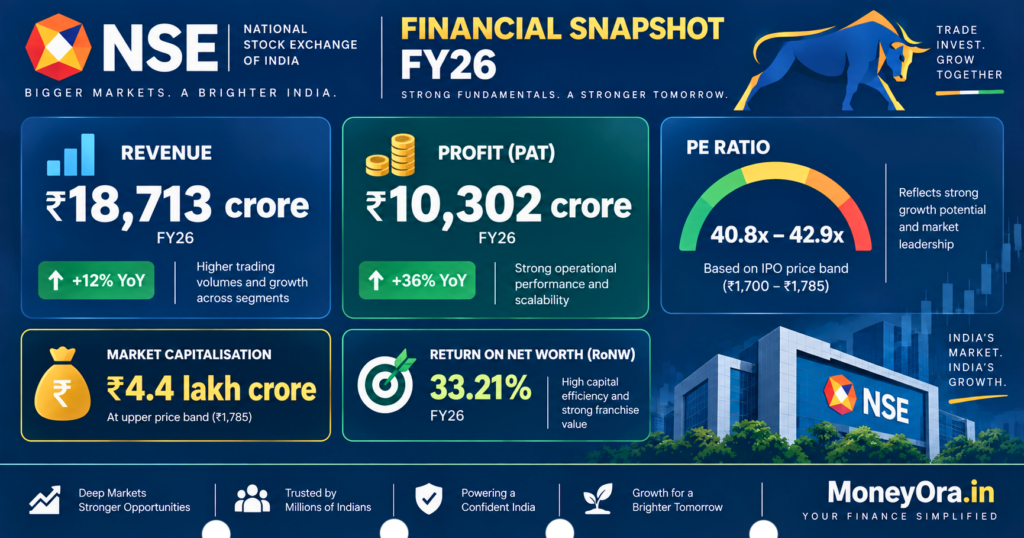
This isn’t your average company going public for the time. The National Stock Exchange reported a profit of Rs 10,302 crore in the financial year 2025-26. Its total revenue was Rs 18,713 crore. The NSE runs India’s options market which’s the biggest single-exchange derivatives platform in the world by number of contracts traded. It serves over 12.9 crore registered investors.
When the NSE IPO 2026 lists on the BSE on September 24 its market value is expected to be between Rs 4.2 lakh crore and Rs 4.4 lakh crore. That makes it one of the IPOs in Indian history.
This guide gives you all the facts you need to know before applying or making a decision. We cover the price band, lot size, minimum investment amount, allotment date listing date and the grey market premium (GMP) as of September 18. You’ll also find a breakdown of the financials key risk factors from the RHP and a simple explanation of whether the NSE IPO 2026 is worth subscribing to.

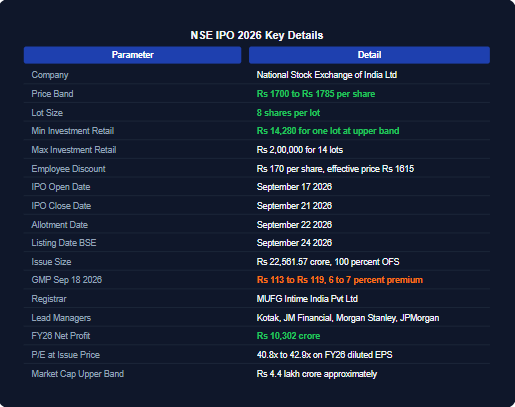
NSE IPO 2026 Key Facts at a Glance. I hope you find these details handy.
- Price band ranges from Rs 1700 to Rs 1785 for each equity share. Issue price at the band is Rs 1785.
- Lot size equals 8 shares. Minimum retail investment for one lot at the price band is Rs 14,280.
- Subscription window spans from September 17 to September 21 2026. It closes on Monday evening.
- Allotment occurs on September 22. Shares are credited by September 23. BSE listing takes place on September 24.
- Total issue size amounts to Rs 22,561.57 crore. NSE IPO 2026 is a 100 percent open offer scheme.
- Anchor investors received shares worth Rs 6,746 crore on September 16.
- GMP on September 18 ranges from Rs 113 to Rs 119 indicating a 6 to 7 percent listing gain.
- FY26 net profit reached Rs 10,302 crore. P/E at issue price lies between 40.8x and 42.9x. RONW stands at 33.21 percent.
- Employee quota enjoys a Rs 170 per share discount. Effective employee price is Rs 1615.
- Registrar is MUFG Intime India. Lead managers, for NSE IPO 2026 include Kotak, JM Financial, Morgan Stanley and JPMorgan.
NSE IPO 2026 Quick Reference Table
NSE IPO 2026 Issue Structure and What OFS Means for Investors

The NSE IPO 2026 is completely structured as an Offer for Sale Each share that is being sold comes from a shareholder of NSE. The National Stock Exchange is not creating any shares and will not get any rupee from this public offering. All the money collected goes directly to the shareholders who are selling their shares.
The total number of shares offered in the NSE IPO 2026 is 12.64 crore. This is less than the 14.9 crore shares that were first suggested in the DRHP submitted in June 2026. NSE decreased the size of the Offer for Sale by 15 percent before deciding on the price range. This change also lowered the issue size from the initial estimate of about Rs 30,000 crore to Rs 22,561.57 crore.
If NSE had kept the size of the Offer for Sale the NSE IPO 2026 would have been the biggest public offering in India. It would have beaten the Rs 27,870 crore issue from Hyundai Motor India in 2024. The Rs 22,561 crore issue is still in the five largest IPOs in the history of the Indian stock market.
On September 16 2026 the day before the public subscription started for the NSE IPO 2026 anchor investors were given Rs 6,746.18 crore worth of NSE shares. As reported by BusinessToday the NSE IPO 2026 was fully subscribed by the day. Qualified Institutional Buyers had 1.32 times the subscription Non-Institutional Investors had 1.35 times and the employee part had 1.36 times. The retail part was at 65 percent according to the report.
For investors the structure of the NSE IPO 2026 as an Offer for Sale has two important effects. First the capital and operations of NSE are not affected by the IPO. The exchange keeps running the way as before no matter how the listing performs. Second the business results are not linked to the IPO results. This is important when you look at the NSE IPO 2026 as a long-term investment than a quick trade.
The main managers for the NSE IPO 2026 are Kotak Mahindra Capital, JM Financial, Morgan Stanley India, Citigroup Global Markets, HSBC Securities and JPMorgan India. The company in charge of allocating shares and handling refunds is MUFG Intime India Pvt Ltd. You can check your allocation using the MUFG Intime website, the BSE portal or the NSE portal with your PAN number, after September 22 2026.
NSE IPO 2026 Price Band, Lot Size and Investment Amounts
The NSE IPO 2026 price range is Rs 1700 to Rs 1785 for each share. Most investors will place their bids at the cut‑off price, which means you automatically bid at the top of the range at Rs 1785. This is practice for retail IPO applications in India – bidding at cut‑off keeps you in the game if the final issue price ends up at the top of the range.
The lot size for the NSE IPO 2026 is 8 shares. You must apply in lots. At the price of Rs 1785 one lot costs Rs 14,280. Two lots cost Rs 28,560. Three lots cost Rs 42,840. The biggest retail application of 14 lots costs Rs 1,99,920, which’s close to the Rs 2 lakh retail limit set by SEBI.
Employees of NSE have an advantage in the NSE IPO 2026. SEBI has set aside 4,33,437 shares for NSE employees with a discount of Rs 170 per share. That makes the price for employees Rs 1615 per share compared to the Rs 1785 price for investors. On one lot of 8 shares that’s a saving of Rs 1,360.
High‑net‑worth or non‑institutional investor applications start at 15 lots worth Rs 2,14,200 and grow in whole‑lot steps. QIBs bid through the book‑building process with no set lot ceiling. The NSE IPO 2026 reservation plan follows the mainboard split about 50 percent for QIBs 15 percent for NIIs and 35 percent, for retail investors.
NSE IPO 2026 GMP Today and What It Signals
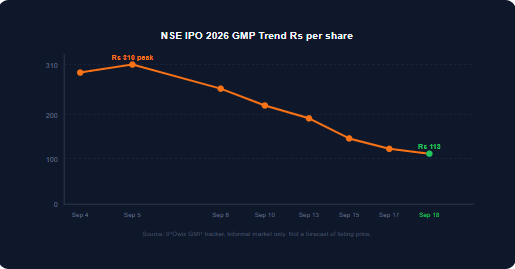
Grey market premium data for the NSE IPO 2026 tells an interesting story about how market sentiment has shifted since the price band announcement. The GMP opened at Rs 285 on September 4 and rose to a peak of Rs 310 on September 5. That peak implied a listing price of around Rs 2,095 and a listing gain of approximately 17 percent over the issue price of Rs 1785.
Since then the GMP for the NSE IPO 2026 has trended downward steadily. As of September 18 2026 it stands at Rs 113 to Rs 119 according to data from IPOwiz, implying a listing price of approximately Rs 1898 to Rs 1904 and a listing gain of 6 to 7 percent over the issue price.
This GMP compression from Rs 310 to Rs 113 in under two weeks is worth understanding before you apply for the NSE IPO 2026. It typically happens when subscription numbers come in below grey market expectations. QIB subscription at 1.32x and retail at 65 percent on Day 2 are healthy but not spectacular by the standard of marquee Indian IPOs which often see 10x to 100x oversubscription. The grey market is pricing in a more modest listing for the NSE IPO 2026 than early buzz suggested.
Grey market numbers are unofficial and do not appear on any regulated exchange. They shift daily and can reverse sharply in the final hours before a listing. The actual NSE IPO 2026 listing price on September 24 will depend on live market demand at opening broader Nifty levels on that day and the final overall subscription ratio after September 21. Treat GMP as a sentiment indicator only. For live GMP tracking Chittorgarh updates NSE IPO 2026 GMP data multiple times daily.
NSE IPO 2026: Company Background and Why This Took a Decade
The National Stock Exchange was founded in 1992. Started trading in 1994. NSE was the Indian exchange to offer fully electronic trading replacing the open‑outcry system that BSE used at that time. NSE launched the Nifty 50 index in 1996. Began selling equity derivatives in 2000. Those derivatives would later become the source of revenue for NSE.
NSE first filed a DRHP for an IPO in December 2016 hoping to raise about Rs 10,000 crore. A months later SEBI put the IPO on indefinite hold after allegations that certain high‑frequency trading firms had preferential access via the colocation facility at NSE’s data centre. That colocation controversy kept NSE out of the markets for almost a decade.
SEBI’s investigation ran for years. NSE eventually filed settlement applications with SEBI. Set aside a provision of Rs 1,297 crore in Q2 FY26 to cover the proposed settlements for the colocation and dark fibre cases. As those settlements moved forward SEBI approved the DRHP in September 2026 clearing the way for the NSE IPO 2026 to finally go ahead.
The decade‑long wait matters to investors in the NSE IPO 2026 because the settlement applications are unfinished. Any future SEBI action that comes from the pending enforcement proceedings will stay listed as a risk factor in the RHP. This risk is not trivial. It is a disclosed, provisioned and legally moving risk, not an unknown liability.
Today NSE holds a dominant spot in India’s capital market. As of March 31 2026 NSE had 12.9 crore investors, 25.37 crore investor accounts, 1,325 trading members and 2,978 listed companies with a total market capitalisation of Rs 411.25 lakh crore. NSE moved Rs 20.33 lakh crore, in fund mobilisation during FY26.
NSE IPO 2026 Financials: Revenue, Profit and Valuation
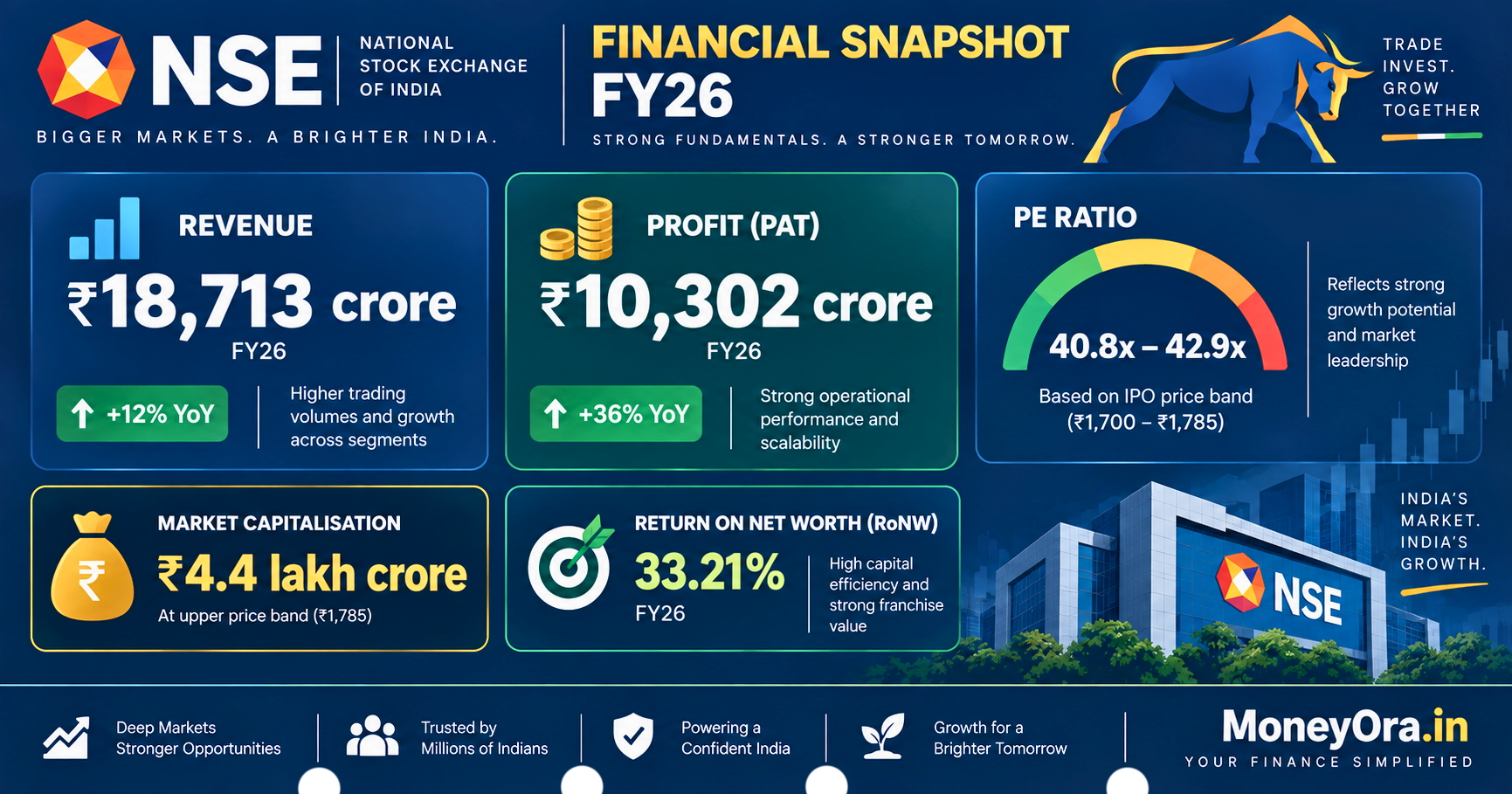
NSE’s financial profile makes the NSE IPO 2026 interesting for investors who plan to stay for the long term. The company earned a profit of 3,210.08 crore rupees from revenue of 5,252.17 crore rupees in the quarter that ended on June 30 2026. In the year 2025‑26 the company earned a net profit of 10,302.06 crore rupees from revenue of 18,713.37 crore rupees according to BusinessToday and Groww.
A net profit margin of 55 percent on revenue of 18,713 crore rupees is extraordinary by any standard. Most listed financial infrastructure companies around the world have margins between 30 and 45 percent. The NSE IPO 2026 margin shows how the exchange runs with capital but high volume. When the technology is built more trading volume passes through. Brings very high profit on each extra unit.
The return on worth for the NSE IPO 2026 company is 33.21 percent. The price‑to‑book ratio at the issue price is 13.76 times. With a share price of 1,785 rupees the NSE IPO 2026 values the company at about 40.8 to 42.9 times the FY26 diluted earnings. This implies a market capitalisation of 4.4 lakh crore rupees at the price level.
Is that expensive? Compared to Indian exchanges it is not outrageous. BSE trades at a price‑to‑earnings ratio of about 70 to 80 times in the market as of mid‑September 2026 so the NSE IPO 2026 price‑to‑earnings ratio of 42 times looks almost reasonable. Worldwide, exchanges such as CME and Intercontinental Exchange trade at 25 to 40 times earnings even though they’re in older markets with less growth expectation.
The concentration risk in the NSE IPO 2026 story is real and should be understood. Transaction charges made up 78.65 percent of the NSE IPO 2026 revenue from operations in FY26 and the options business alone made up 60.22 percent. This means most revenue comes from one product that can change with regulations. The top ten trading members provided 46.78 percent of the revenue from operations creating a risk if any large member cuts back.
Way2Wealth Research gave the NSE IPO 2026 a subscribe‑for‑long‑term rating saying it is a business and one of the best large‑cap chances from India in recent years. Karma Capital’s portfolio manager called it a growth story and said the NSE IPO 2026 could become a steady compounder over time. Most institutional analysts agree,. They warn that the gains on the listing day may be modest because of the current GMP trend.
If you are building a long‑term portfolio while applying for IPOs MoneyOra’s comparison of FD versus liquid funds for parking short-term money that is locked during the NSE IPO 2026 application period.
NSE IPO 2026 Key Risks From the Red Herring Prospectus
Every RHP contains a risk factor section. For the NSE IPO 2026, three risks stand out as genuinely material rather than boilerplate legal language.
The first is F&O revenue concentration. Transaction charges from derivatives trading contributed 60.22 percent of total revenue in FY26. If SEBI’s ongoing efforts to moderate retail F&O participation succeed NSE’s transaction volume and revenue could fall. The exchange has limited ability to offset this by raising rates without risking volume moving to alternative venues. This is the single most important structural risk for anyone holding the NSE IPO 2026 beyond the listing day.
The second risk is regulatory and legal overhang from the colocation era. Ongoing enforcement actions pending regulatory proceedings and adjudication actions by SEBI carry significant financial, operational and reputational uncertainty. The settlement applications are in progress but not concluded Any adverse SEBI order could result in additional penalties or conditions affecting NSE’s business model.
The third is cybersecurity NSE is exposed to cybersecurity risks affecting its trading, clearing, settlement and other critical systems. The RHP discloses a distributed denial of service attack experienced in May 2025 involving approximately 395 million hits within 11 minutes which slowed its multilingual website. NSE also received a SEBI warning dated May 9 2025 for shortcomings in its cybersecurity audit processes. For an exchange that processes millions of trades daily a successful cyberattack carries operational regulatory and reputational consequences well beyond any immediate disruption.
These risks do not make the NSE IPO 2026 a bad investment. They are among the reasons the issue is priced at 42x earnings rather than 70x. Understanding them helps you size the investment appropriately. If the NSE IPO 2026 forms part of broader financial planning that includes EMIs or active loans, MoneyOra’s guide on borrowing costs and investment sequencing is worth reading before committing application funds.
How to Apply for NSE IPO 2026: Step-by-Step for Retail Investors
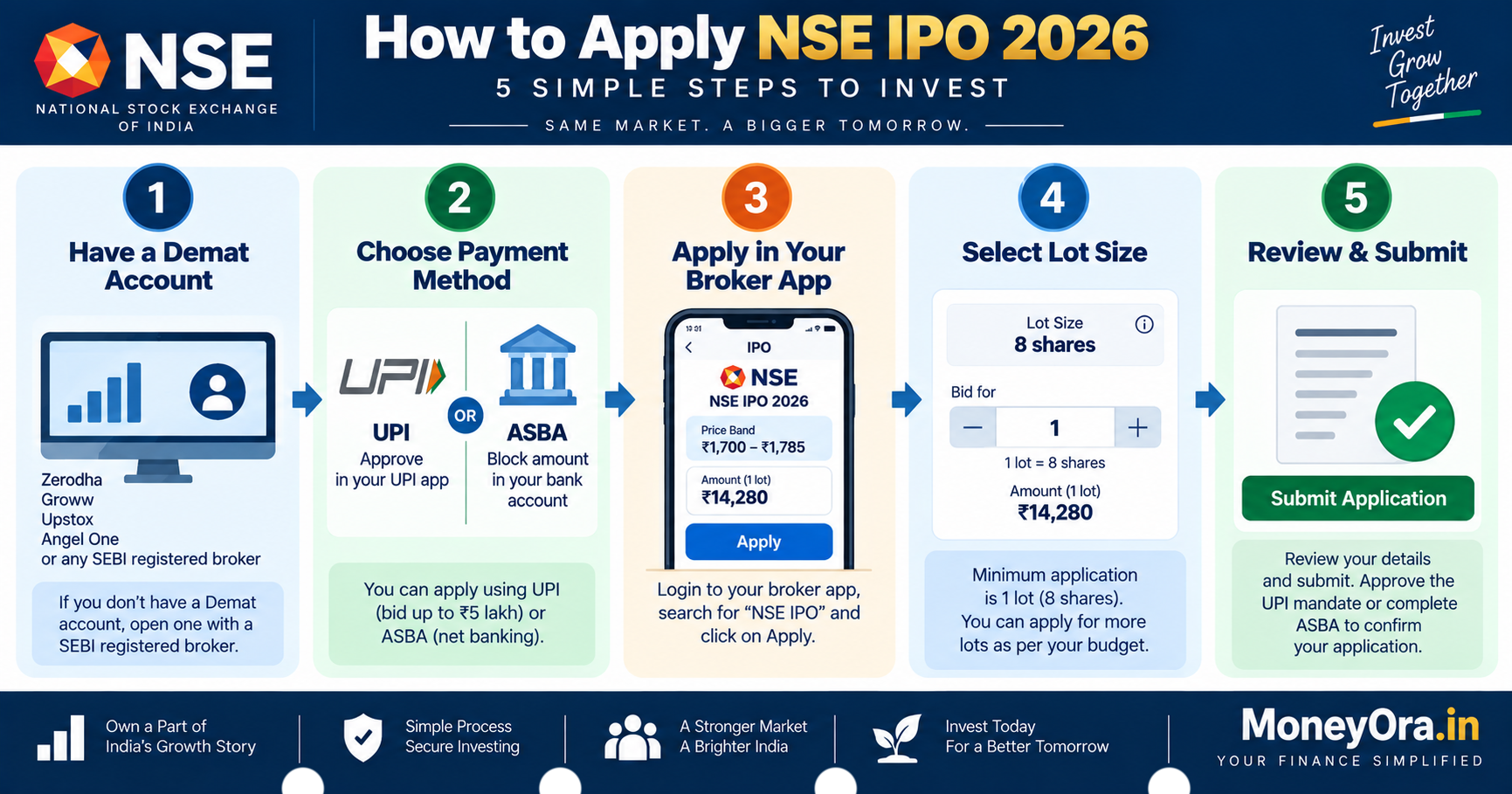
The NSE IPO 2026 subscription window closes on September 21 2026. You need three things before you start. First a demat account linked to your PAN. Second a bank account with UPI. Net banking enabled for ASBA. Third enough funds in your account to cover the application amount. The money is. Not debited until allotment.
Through your broker app such as Zerodha, Groww, Upstox or 5Paisa log in. Navigate to the IPO section. Find NSE IPO 2026 in the list of IPOs. Select the number of lots you want to apply for. One lot is 8 shares at Rs 14,280. Most retail investors apply for 1 lot to maximise their chances in the allotment lottery given the expected oversubscription.
Choose the cut-off price option to automatically bid at the top of the band at Rs 1785. Enter your UPI ID. Confirm the application. A mandate request will appear on your UPI app within minutes. Approve the mandate before it expires. The amount is blocked in your account. Not transferred until allotment.
If you prefer ASBA through banking log into your bank portal and look for the IPO application section under investments. Search for NSE IPO 2026 enter the number of lots and your demat account details and submit. HDFC, SBI, ICICI and Axis all support ASBA for mainboard IPOs directly through banking.
A few critical checks before submitting your NSE IPO 2026 application. Make sure the name on your demat account exactly matches your PAN. Joint applications are not permitted in IPOs. One application per PAN number is allowed. Multiple applications from the same PAN result in all of them being rejected. If you hold a joint bank account the holders PAN must match the demat account PAN.
You can check your NSE IPO 2026 allotment status from September 22 2026 on the MUFG Intime website on the BSE IPO allotment page using your PAN or application number or, through your broker app. Allotted shares will appear in your demat account by September 23. Trading begins on BSE on September 24.
NSE IPO 2026 Subscription Status on Day 2
As of the end of Day 2 on September 18 2026, the NSE IPO 2026 was fully subscribed at 1x overall. Bids were placed for 8,88,23,000 equity shares against 8,86,42,911 shares on offer as of 2:55 PM. Breaking it down by category, QIBs subscribed their portion 1.32 times, NIIs subscribed 1.35 times, the employee quota was booked 1.36 percent and retail investors had bid for 65 percent of their reserved portion.
These subscription numbers suggest the NSE IPO 2026 will close fully subscribed but likely not at the spectacular multiples seen in some recent smaller IPOs. The final subscription ratio announced after September 21 close will determine allotment probability for retail investors. In a 2x to 3x oversubscribed IPO the lottery odds are still reasonable for a retail investor applying for one lot.
The relatively modest subscription on Day 2 of the NSE IPO 2026 reflects the issue size as much as anything else. At Rs 22,561 crore, this is an enormous public offering. Getting to even 2x overall subscription requires Rs 45,000 crore in bids – a sum that stretches the capacity of any single IPO window in India. Big issues almost always see lower subscription multiples than smaller ones, so lower numbers should not be read as a lack of investor interest in the NSE IPO 2026 specifically.
NSE IPO 2026 compared to NSDL IPO 2025: Information for Investors
investors who signed up for the NSDL IPO in August 2025 have a good example to look at for the NSE IPO 2026. NSDL set the price of its IPO between Rs 760 and Rs 800. The lot size was 18 shares. The minimum amount needed to invest was Rs 14,440. NSDL got applications that were 41 times the offer. Qualified Institutional Buyers showed a lot of interest with 103.97 times subscription. The NSE IPO 2026 is similar in structure. It is another financial infrastructure company going public Nse is a much bigger business. The revenue of NSE is ten times that of NSDL.
For investors who found the NSDL IPO beneficial the NSE IPO 2026 is the step in owning parts of Indias capital market infrastructure. NSDL keeps your shares safe. NSE is the place where you trade those shares. Together they are the base of the stock market. Owning both gives a connection to the growth of the financial market in India. This is without depending on how each company does in an industry.
The minimum investment for both is the same. For NSDL it is Rs 14,440. For NSE IPO 2026 it is Rs 14,280. This makes it possible for many salaried people to take part. These people use part of their savings to apply for new issues. If you want to know what your CIBIL score should be, before adding any investment or EMI to your life MoneyOras credit health guide has the basics.
Should You Apply for NSE IPO 2026: An Honest Assessment
This question has no single clean answer. Anyone who tells you the NSE IPO 2026 is definitely a listing-gain trade or definitely a long-term compounder is simplifying a genuinely nuanced decision. Here is a more honest breakdown.
The case for applying is rooted in business quality. NSE is the closest thing India has to a regulated monopoly in equity derivatives. The Nifty 50 options market is the largest in the world by contract volume. Switching costs for trading members are near-zero on paper but near-infinite in practice – the liquidity ecosystem around NSE’s contracts took decades to build and cannot be replicated quickly. The NSE IPO 2026 gives you a business that earns 55 percent net margins, generates massive free cash flow and carries a debt-free balance sheet. These are rare qualities in any listed company.
The case for caution in the NSE IPO 2026 is equally grounded. The issue is priced at 42x earnings. GMP has fallen from Rs 310 to Rs 113 in two weeks – grey market participants are revising down their listing gain expectations in real time. The F&O concentration risk is real. SEBI has been tightening derivatives rules since 2024 and there is no credible signal that this regulatory direction will reverse soon. The colocation settlement overhang while provisioned has not been fully resolved.
For a long-term investor with a 5 to 10 year horizon who believes India’s capital market participation rate will double or triple from the current roughly 10 percent of households, the NSE IPO 2026 is one of the few ways to directly own the infrastructure that benefits from that structural growth. This is a case where the business thesis is stronger than the listing day price thesis.
For someone chasing a short-term listing gain the NSE IPO 2026 looks less attractive than it did two weeks ago. A 6 to 7 percent listing gain as suggested by current GMP is real money but thin relative to the capital blocked for 7 days during the application period. The cleanest decision framework is this if you would hold NSE shares for 3 to 5 years without checking the price every week apply at cut-off for one lot. If you are applying purely for a listing day flip the risk-reward looks unfavourable at current GMP levels.
Before you apply for the NSE IPO 2026 using borrowed funds or funds earmarked for something else MoneyOra’s analysis of how to manage loan eligibility and financial commitments by income is worth reading.
How to Check NSE IPO 2026 Allotment Status
The allotment for the NSE IPO 2026 is finalised on September 22 2026. There are three ways to check if you have received shares.
Through the registrar MUFG Intime India visit the ipolisting.com website. From the dropdown select the NSE IPO 2026. Enter your PAN, application number or demat account ID and submit. The allotment status will appear as allotted or not allotted. The number of shares will be shown.
Through BSE go to the BSE IPO allotment status page at bseindia.com. Choose the company listed as National Stock Exchange of India. Enter your PAN or application number. Check the status.
Through your broker app many brokers such as Kotak Neo and Groww send notifications on September 22 after the allotment is processed. If you did not receive the allotment the blocked funds will be returned to your bank account by September 23. If you did receive the allotment the shares will appear in your demat account by September 23. You can trade them from the opening bell, on BSE on September 24.
NSE IPO 2026 Employee Quota and Discount Details
The NSE IPO 2026 includes a reservation of 4,33,437 shares for NSE employees with a discount of Rs 170 per share. Their effective price is Rs 1615 versus the retail price of Rs 1785. On one lot of 8 shares that discount saves an NSE employee Rs 1,360. The employee portion was subscribed 1.36 percent as of Day 2.
NSE employees who apply through the employee reservation quota must apply through the broker linked to their employment records. Employees cannot double-apply once in the employee quota and once in the retail quota using the same PAN. If the employee quota is not fully subscribed the remaining unsubscribed portion may be reallocated to other categories depending on SEBI guidelines applicable at allotment.
Bottom Line on NSE IPO 2026
The NSE IPO 2026 is the end of a decade-long wait and the beginning of a phase where India’s most important financial exchange is accountable to public shareholders with quarterly results and a listed price that reflects real market sentiment.
The business behind the NSE IPO 2026 is exceptional. A 55 percent net margin, Rs 10,302 crore net profit, 33.21 percent return on net worth and a structurally growing user base are rare qualities in any listed asset anywhere. The price at 42x earnings is fair for what you get – not cheap but not absurd given BSE’s 70x multiple and NSE’s dominant position in the world’s largest derivatives exchange by volume.
The short-term listing story for the NSE IPO 2026 has cooled from the early excitement. GMP at Rs 113 suggests a modest listing gain, not a windfall. Anyone applying for the NSE IPO 2026 purely for a Day 1 profit should factor that expectation into the decision carefully. For long-term investors who believe in India’s financial market growth and want to own the infrastructure at the centre of it the NSE IPO 2026 is one of the most meaningful primary market opportunities in years.
Apply through your preferred broker before September 21 2026. Check your NSE IPO 2026 allotment status on MUFG Intime from September 22. Review your complete financial picture before committing – MoneyOra’s guide on hidden financial costs that erode savings quietly is useful context before you decide how much to allocate. Use the free calculators on MoneyOra.in to plan your investment portfolio around this listing. Use the free calculator now on MoneyOra.in →