
UPI Charges 2026: New MDR Rules From October 15 Explained for Indians
Your phone buzzes. Someone has just paid you five thousand rupees through UPI. A seconds later a friend texts asking whether UPI is now chargeable. Millions of Indians woke up to the question on September fifteen 2026 when NPCI announced the MDR framework. Within hours the rumor mill was spinning. Indians were convinced that UPI would now cost extra every time they scanned a QR code.
They will not Merchants receiving large payments will. The reality of the UPI charges 2026 rules is more nuanced than the panicked social media posts suggest and the nuance matters enormously if any shop owner any clinic owner any restaurant owner or any business owner that collects UPI payments is reading this.
This guide covers everything you need to know about the October fifteenth changes in language. What changes from October fifteenth. Who pays. Who is fully exempt. How the MDR is calculated on rupee amounts What the government has explicitly said will never be charged to ordinary users.
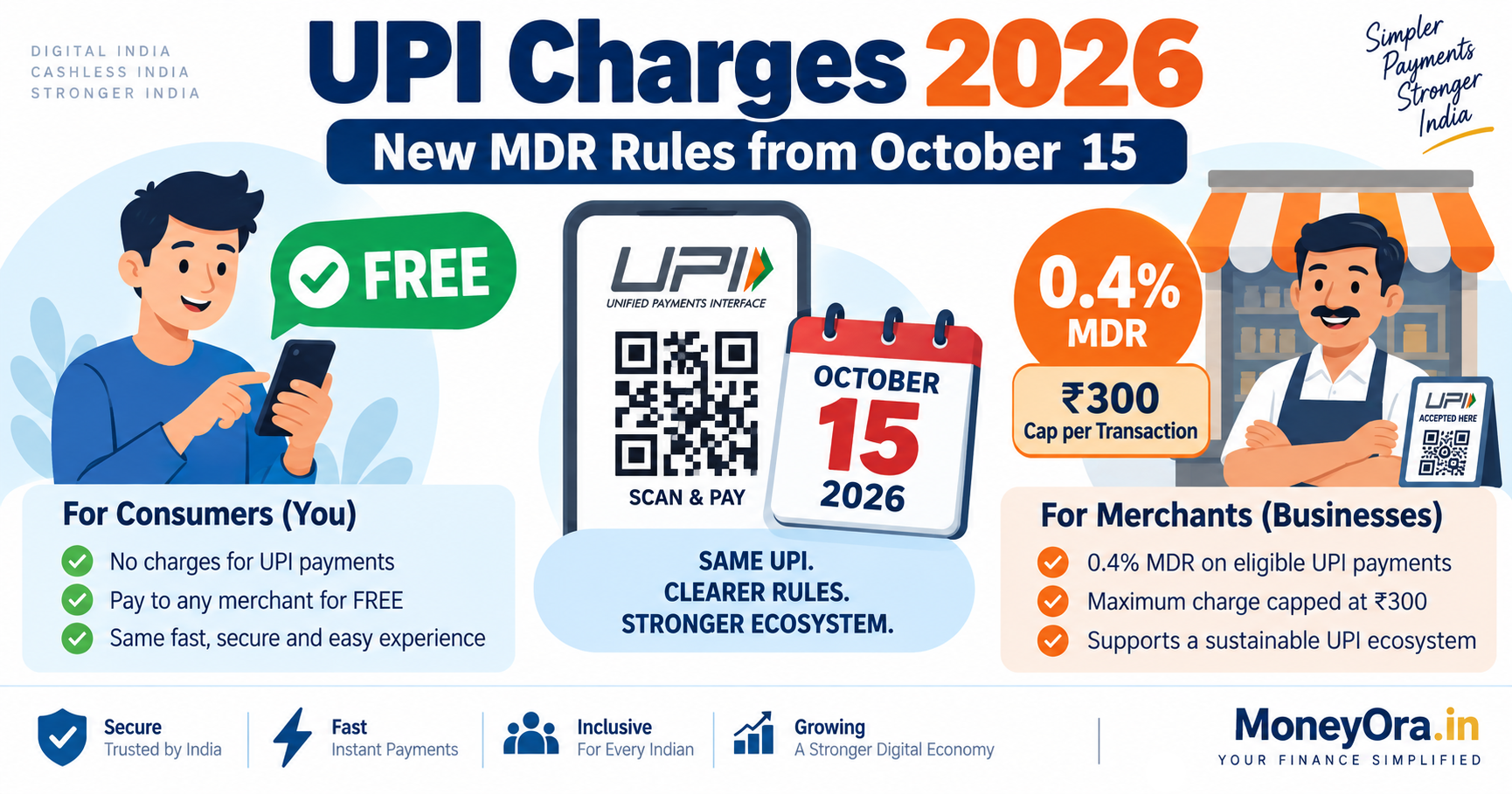
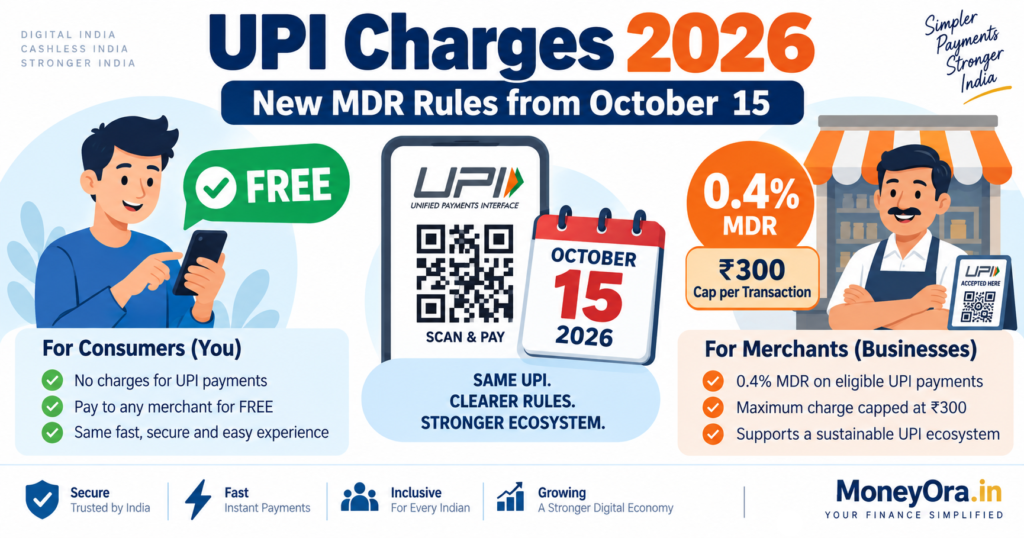
- NPCI introduces a 0.4% MDR on eligible merchant UPI payments above Rs 2000 starting October 15 2026.
- The the MDR is a merchant-side cost. Customers pay zero. UPI apps cannot add surcharges to consumer payments.
- Small merchants in the P2PM category receiving under Rs 1 lakh per month stay fully exempt from UPI charges 2026.
- The MDR is capped at Rs 300 per transaction for payments of Rs 75000 and above.
- Essential sectors including railways telecom fuel and insurance pay a flat Rs 5 MDR instead of 0.4%.
- P2P transfers sending money to anyone remain completely free regardless of amount.
- 5% of all MDR collected goes into a dedicated fund to help small merchants and expand digital payments in rural India.
What Are UPI Charges 2026. Why Are They Happening Now
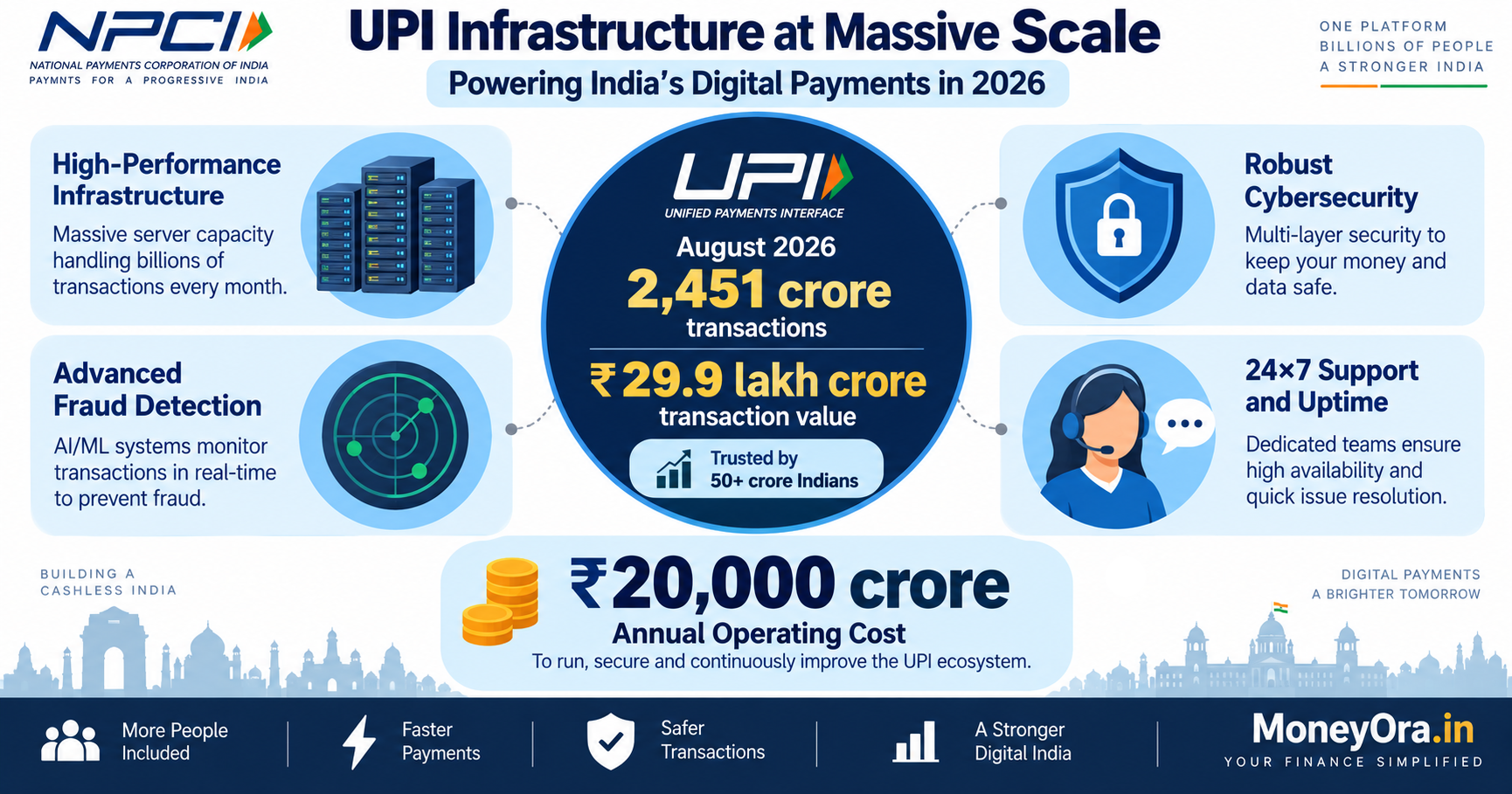
The story of UPI charges 2026 starts not with greed but with numbers. In August 2026 UPI handled 2451 crore transactions Rs 29.9 lakh crore according to NPCI data cited by Business Today. That is a number and it brings a huge operating cost. Industry estimates say that running UPI servers, bandwidth, cybersecurity, fraud detection, customer support and banking technology costs about Rs 20,000 crore each year.
From 2020 until September 2026 the government covered most of this cost with incentive payments to banks and payment service providers. That arrangement was always called a short‑term support tool not a funding plan. The UPI charges 2026 MDR framework is NPCIs move to create a self‑sustaining payment system that does not rely on government subsidies every year.
The National Payments Corporation of India released the framework on September 15 2026. The Ministry of Finance issued a FAQ that same day saying that UPI charges 2026 do not affect consumers and that no platform fees will be allowed on the customer side. The framework starts on October 15 2026 giving merchants and payment service providers a 30‑day period to update their systems.
If you are a salaried worker who uses UPI to pay rent send money home or bills with friends this announcement changes nothing for you. Read on anyway because knowing what your merchant pays can help you see whether they can legally charge you extra. They cannot. You should know that.
The Complete The Complete MDR Rate Table Explained
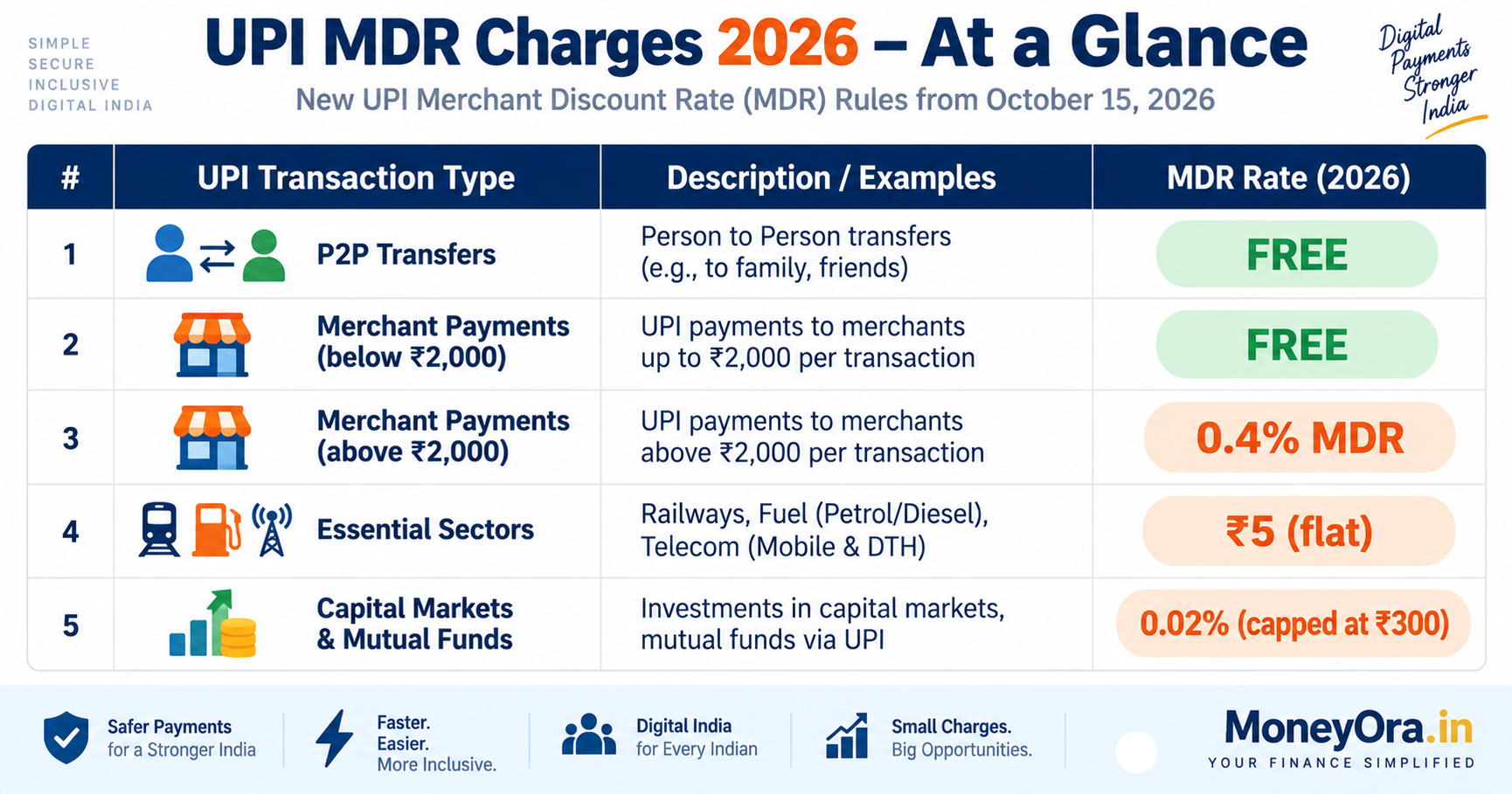
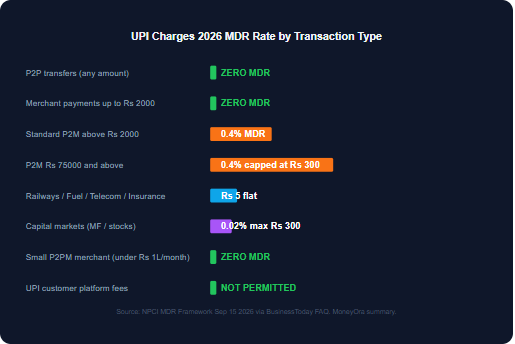
The this MDR framework is not one flat rate applied to everything. It is a tiered system with different rates for different transaction types and sectors. Here is the full picture based on the official NPCI announcement and the BusinessToday MDR FAQ published September 15 2026.
Person-to-Person transfers
Zero MDR Always No matter how much you send Rs 5 lakh transferred to a family member via UPI attracts no charge on either side This was the most important clarification in the UPI charges 2026 announcement and the Finance Ministry stated it explicitly. UPI will continue to remain completely free for all person-to-person transactions irrespective of the amount transferred.
Merchant payments up to Rs 2000
Zero MDR. Whether you pay Rs 50 for a vada pav or Rs 1,999 for a jacket at a mall the merchant receives the full amount and pays no processing fee. NPCI confirmed that payments up to Rs 2000 account for more than 95% of all P2M UPI transaction volume. The framework was deliberately designed to leave the vast majority of everyday purchases completely untouched.
Standard merchant payments above Rs 2000
This is where the MDR kicks in for eligible merchants The rate is 0.4% of the transaction value A merchant receiving Rs 3,000 pays Rs 12. A merchant receiving Rs 50,000 pays Rs 200. The charge is borne entirely by the merchant and is shared among the payment ecosystem participants including the acquiring bank the payment service provider and UPI app providers.
High-value merchant payments of Rs 75000 and above
The the framework caps the MDR at Rs 300 per transaction for any payment of Rs 75,000 or more. Without this cap a Rs 1 lakh payment would attract Rs 400 in MDR at the 0.4% rate. The cap brings it down to Rs 300. A Rs 5 lakh transaction also pays just Rs 300. This ceiling matters a great deal for businesses like jewellers electronics retailers and automobile dealers who regularly receive large payments via UPI.
Essential sector flat fee
Railways, telecom services, insurance companies, fuel stations and agricultural input suppliers fall into a concessional category under the UPI charges 2026 rules. Instead of paying 0.4% these sectors pay a flat Rs 5 MDR per transaction above Rs 2000. A petrol pump receiving a Rs 4,000 fuel payment pays Rs 5 not Rs 16 A railway booking of Rs 8,000 carries a Rs 5 MDR not Rs 32 This concessional rate recognises the thin margins in these sectors and the high frequency of such essential payments.
Capital market transactions
Mutual fund purchases, securities transactions, stockbroker payments and dealer settlements follow their own separate structure. The MDR here is 0.02% capped at Rs 300. On a Rs 10,000 SIP payment that is just Rs 2. On a Rs 5 lakh equity purchase it is Rs 100. For investors using UPI for their SIPs and stock trades the cost impact is negligible.
Small P2PM merchants
Eligible small merchants in the Person-to-Person-Merchant category continue at zero MDR. The detail on who qualifies appears in its own section below. This is arguably the most important part of the new rules for India’s massive informal economy.
Real Rupee Examples: How Much MDR Does a Merchant Pay
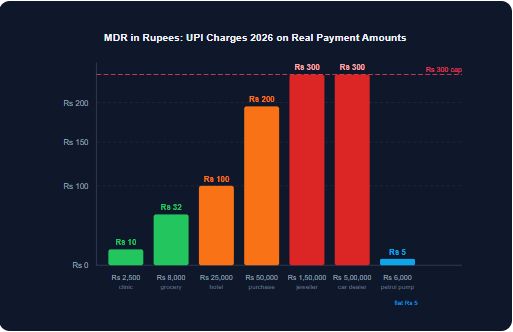
Rate tables can be abstract Here is what the UPI charges 2026 MDR actually costs in rupees across a range of payment sizes that Indian merchants encounter daily.
A medical clinic billing Rs 2,500 for a consultation will pay Rs 10 in MDR at 0.4%. Over 200 such payments in a month that is Rs 2,000 meaningful but not catastrophic for a running practice.
A jewellery shop receiving a Rs 1,50,000 gold purchase via UPI pays Rs 300 under the Rs 300 cap even though 0.4% of Rs 1,50,000 would be Rs 600. The Rs 300 ceiling saves the merchant Rs 300 on that single transaction.
A supermarket receiving Rs 8,000 for a monthly grocery run pays Rs 32 in MDR A hotel billing Rs 25,000 for a weekend stay pays Rs 100. A car dealer accepting Rs 5 lakh for a used vehicle pays Rs 300 under the cap not Rs 2,000 as 0.4% would ordinarily compute.
A petrol pump receiving Rs 6,000 for a full tank pays just Rs 5 under the concessional essential-sector rate, not Rs 24 at standard MDR. Same for a railway booking of Rs 12,000 the flat Rs 5 applies rather than Rs 48 These concessional rates exist precisely because margins at fuel stations and essential service providers are already thin.
An investor buying units of an equity mutual fund worth Rs 50,000 via UPI pays nothing extra. The fund’s AMC pays Rs 10 in MDR at the 0.02% capital market rate. That is a rounding error on a Rs 50,000 investment.
Who Pays UPI MDR Charges: Merchant or Customer
This was the question that caused the worry when news of the new UPI rules came out. The answer is clear. Has been confirmed at the highest level by the Finance Ministry and NPCI.
The merchant pays. The customer pays nothing.
Specifically the MDR is not taken from the payment the customer makes. If you scan a QR code and pay Rs 10,000 the merchant gets Rs 10,000. The MDR of Rs 40 is handled separately by the merchants acquiring bank from the merchants settlement account. From the customer’s point of view the payment experience is the same as it was before October 15.
The NPCI FAQ published by OneIndia on September 15 2026 says this directly. UPI applications are not allowed to charge consumers for making UPI payments. The merchant cannot pass the MDR to you by adding a surcharge at the billing counter. If a merchant says there is a 0.4% charge for UPI payment they are breaking the NPCI rules and you can refuse to pay it.
This difference between merchant-side processing cost and consumer-facing surcharge is the model used for credit card MDR in most countries and in India before 2020 for debit cards. The merchant takes the cost as part of running the business. If you have been looking at this compared to your hidden bank charges you might find MoneyOras hidden bank charges costing Indians Rs 2,000 a year useful context. The new MDR structure is different, in one way they are clearly written down and merchants cannot hide them in your bill.
UPI Charges for Small Merchants: The P2PM Exemption Explained
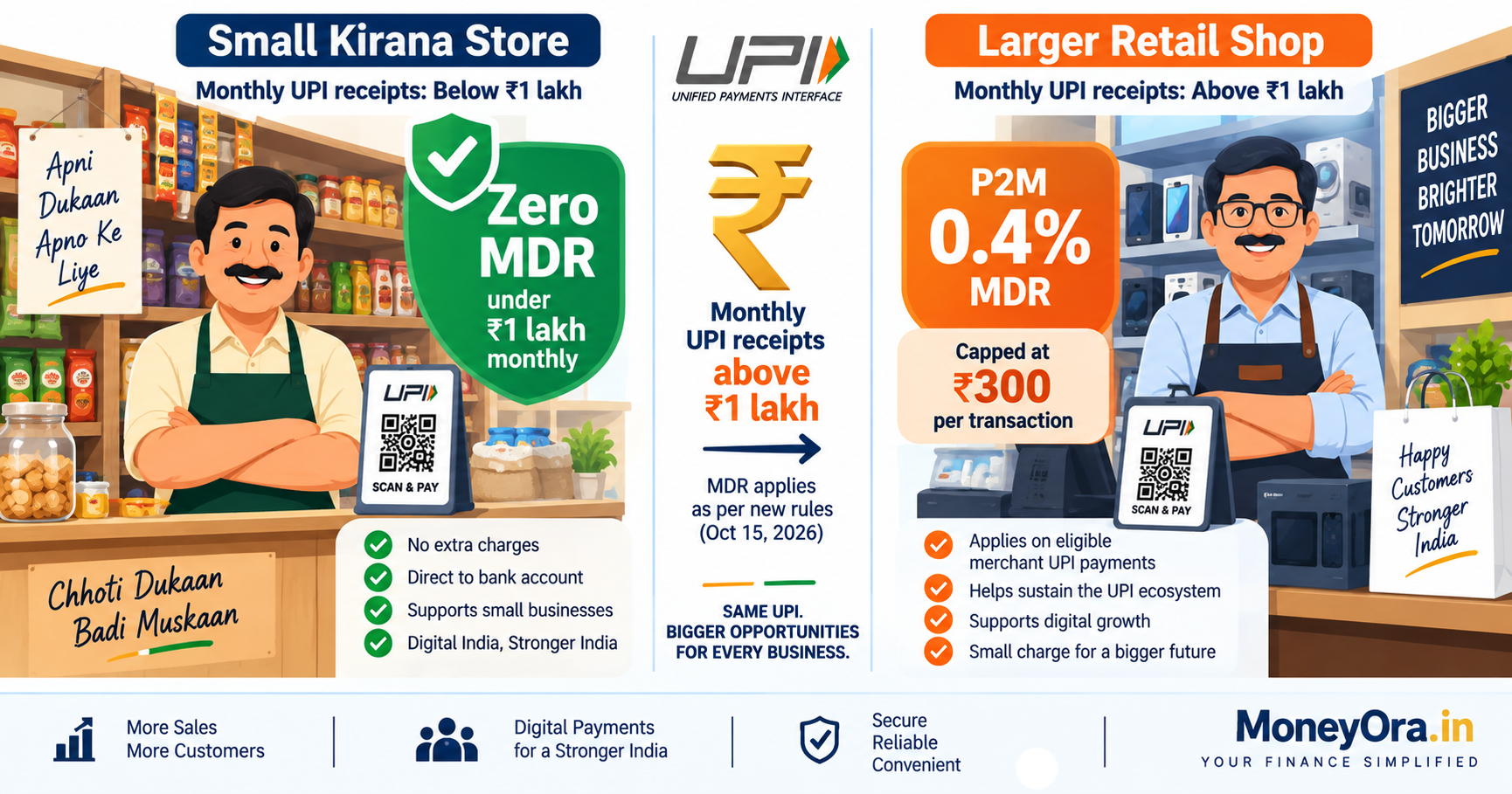
The P2PM Person-to-Person-Merchant exemption is the key element of the UPI charges 2026 framework that will touch tens of millions of traders, street vendors, vegetable sellers, auto drivers, neighbour hood kirana stores and other micro‑businesses across India. I can see why this matters to traders.
If a small merchant receives UPI QR payments into a bank account and the merchant’s total UPI receipts for a month stay below Rs 1 lakh then zero MDR is charged on every transaction. This stays true even if a single payment goes beyond Rs 2,000 or if a customer pays Rs 20,000 for catering services. Long as the monthly total remains below Rs 1 lakh the merchant’s account stays in the P2PM category and the UPI charges 2026 MDR does not apply. I think this will ease merchants worries.
The rule for merchants who grow is also clear. If a merchant’s monthly UPI receipts stay above Rs 1 lakh for three months the acquiring bank will shift the account into the normal P2M category. No sudden bill will appear for transactions; the new MDR rules start only from the reclassification date. NPCI has said that acquiring banks and payment service providers will monitor this so the merchant does not have to keep track. I appreciate the clarity on growth.
Importantly no merchant has to replace the existing QR code or soundbox because of the UPI charges 2026 rules. The current Paytm soundbox or PhonePe QR will keep working as before. While the backend settlement logic changes for merchants in the P2M category the physical equipment on the shop floor stays unchanged. I am relieved that equipment stays the same.
GST registration is not required for the P2PM exemption under UPI charges 2026. Eligibility depends on the merchant category type and the total monthly UPI receipts not on business registration status. This matters a lot for India’s retail sector, where many small merchants run businesses without GST numbers. I know many merchants lack GST numbers.
The Finance Ministry’s own FAQ on UPI charges 2026 mentioned street vendors and neighbour hood shops as the kinds of businesses the P2PM exemption aims to protect. 96% Of all P2M transactions, by volume are projected to stay unchanged under the new framework according to that statement. I trust the Ministry’s guidance.
Why NPCI Introduced UPI Charges 2026: The Infrastructure Argument
There are three reasons NPCI has pushed for UPI charges 2026 at this particular point in time.
The first reason is the scale problem. This is the straightforward. In August 2026 UPI processed 2,451 crore transactions worth Rs 29.9 lakh crore. The infrastructure that supports this volume. Real-time servers, 24×7 banking integrations, fraud detection engines, dispute resolution systems and the IMPS rails behind every transfer. Costs Rs 20,000 crore a year to maintain and upgrade. This estimate comes from industry sources cited by NPCI. Government incentives to banks have helped cover part of this cost.. Those incentives were never meant to be a long-term solution.
The second reason is sustainability. This follows directly from the scale issue. Since 2023 NPCI has consistently argued that a payments network handling the volume UPI now handles needs a commercial revenue model. The government incentives announced each financial year create planning uncertainty for banks and technology providers. The merchant discount rate or MDR creates a revenue stream that grows as transaction volumes grow. This is the kind of self-reinforcing funding model that mature payment networks like Visa and Mastercard use around the world.
The third reason is expansion into markets. The UPI charges 2026 framework includes a fund equal to 5% of all MDR collected. This fund will be used specifically to promote payment adoption in Tier 3 to Tier 6 cities, rural areas and underserved regions. Including the Northeast, Jammu and Kashmir and Ladakh. The detailed framework for this fund is being worked out in consultation with the Reserve Bank of India. It is expected to be finalized within three months of October 15.
Critics of the UPI charges 2026 announcement have pointed out that India’s digital payment adoption story was built on the promise of free transactions. They argue that introducing any cost now creates friction. That is a concern. The counter-argument from NPCI is that 95% of transactions below Rs 2,000 remain free. The MDR, on transactions is modest compared to what merchants previously paid on card transactions, which ran up to 2% before 2020. You can read MoneyOras analysis of credit card charges in 2026 to see how UPI MDR compares to the card world.
New MDR vs Old Card MDR: Is 0.4% Actually Cheap
To understand the UPI charges 2026 MDR it is helpful to compare them with the amounts merchants paid before the UPI era began.
Before January 2020 Debit card MDR was between 0.4% and 0.9% depending on how much the transaction was. Credit card MDR usually ranged from 1.5% to 2.5% in retail categories. International credit cards could have high as 3.5% MDR. These rates were the cost of accepting electronic payments in India during most of the 2000s and 2010s.
UPI at 0.4% for payments over Rs 2,000 is the rate that Indian merchants have ever paid for non‑cash payment acceptance. With the Rs 300 cap UPI becomes cheaper than card MDR for any transaction over Rs 75,000. For example a Rs 3 lakh jewellery purchase would cost a credit card MDR of Rs 4,500 to Rs 7,500 based on rates. Under UPI charges 2026 the same purchase costs the jeweller Rs 300.
Merchants who now accept both cards and UPI still save a lot with the October 2026 framework compared to card MDR even after October 15. The incentive to make customers use UPI of credit card stays strong for most merchants.
If you are a consumer deciding between UPI and credit card for purchases the merchants MDR situation may push some shops to prefer one payment method over the other. MoneyOras comparison of payment option costs for Indian consumers explains this in detail.
Impact on Your Personal Finance Routine from October 15
people reading about UPI charges 2026 want to know one thing. Will anything in my day-to-day money life change from October 15? The answer depends on how you use UPI.
For the salaried employee who uses UPI to pay rent the answer is no. Rent payments from one persons account to a landlords account are P2P transfers. These remain free regardless of amount under UPI charges 2026. No extra cost will show up in your bank statement when you send rent using UPI.
For someone splitting a restaurant bill with friends the answer is also no. P2P splitting via UPI is free. You can split the cost evenly. Round it out without any payment processing fee added.
For someone paying Rs 500 for groceries at the kirana store the answer is still no. The kirana’s monthly UPI receipts are certainly under Rs 1 lakh The payment itself is under Rs 2,000. That means exemption under UPI charges 2026. So neither the customer nor the shopkeeper pays anything
For someone paying Rs 8,000 at a supermarket or pharmacy the merchant falls into the standard P2M category. They pay Rs 32 in MDR The customer pays Rs 8,000 on the bill, not Rs 8,032. The merchant absorbs the MDR as a business cost. You don’t see that charge added to your amount.
The only scenario where a consumer might feel an impact is if a large merchant. Say a mid-size hotel or an electronics retailer. Responds to the UPI charges 2026 MDR by raising prices marginally. That risk exists in theory In practice the 0.4% MDR on a Rs 30,000 TV is just Rs 120. No rational retailer raises the sticker price of a Rs 30,000 TV by Rs 120 specifically to recover UPI MDR. Competitive pressure from retailers offering the same price prevents that.
So most people will not notice any changes to their personal finance routine If you are managing your monthly cash flow carefully you might want to check MoneyOras resources on building an emergency fund and liquid savings. Not because UPI charges 2026 will dent your wallet. Because October 2026 is a good reminder to review all the small financial leaks in your system.
What Happens If a Merchant Adds an Unlawful Surcharge
This is where the consumer protection dimension of UPI charges 2026 matters. NPCI has been explicit. Merchants are prohibited from passing the MDR to customers in any form. No surcharge, no processing fee, no extra percentage added to the bill for choosing to pay via UPI.
If a merchant violates this rule you have several options. You can refuse to pay the extra charge and point the merchant to the NPCI guidelines. You can report the merchant to your bank through the UPI dispute resolution mechanism. Most UPI apps also have a report-a-merchant feature that flags violations to NPCI and the acquiring bank.
From October 15 any UPI app that adds a platform fee to customer transactions is also in violation of the the NPCI framework. NPCI confirmed that UPI app providers are explicitly barred from charging platform fees on the consumer side. This covers all apps including PhonePe, Google Pay, Paytm, BHIM and bank-specific UPI apps.
The consumer protection built into the new MDR structure is actually stronger than what most people know about credit card surcharges. While card surcharges are also technically prohibited in many cases enforcement has been patchy. The the MDR framework creates a clearer prohibition with direct accountability through acquiring banks who monitor their merchant portfolio.
Risks and Things to Watch After October 15 2026
The the MDR framework is well-designed on paper. But three practical risks are worth watching as the October 15 implementation date arrives.
The first is informal surcharging. Despite the prohibition small merchants may add informal charges for UPI when they cross into P2M territory. This will happen most frequently where the customer has no good alternative payment method and the merchant feels squeezed by the MDR. Consumers in areas with limited banking alternatives should be prepared to question any extra charges.
The second is P2PM reclassification surprises. A street food vendor whose business grew rapidly over three months might be reclassified into the P2M category without realising it. If the acquiring bank’s communication of this reclassification is poor the merchant might face unexpected MDR deductions from settlement amounts. NPCI needs to ensure banks communicate reclassifications proactively and with enough notice for merchants to understand the change.
The third is implementation quality across 600-plus banks integrated into UPI. The MDR split logic how the 0.4% is distributed among the acquiring bank, the remitter bank, the payment service provider and the UPI app is new for most systems. Settlement errors in the first few weeks after October 15 are a real risk. Merchants should check their UPI settlement statements carefully during October and November 2026 and raise disputes promptly if deductions look incorrect.
The CIBIL and credit impact angle is less direct but worth noting. Merchants who face unexpected cash flow pressure from MDR deductions may in some edge cases have difficulty repaying business loans. This is a tail risk not a mainstream concern but for any reader who has extended credit to a small business the the October 15 implementation period is one to watch. MoneyOra’s guide on how credit scores work for different loan types covers the broader credit picture.
The Bottom Line on the New UPI MDR Rules
The NPCI MDR framework is a meaningful policy shift but a far smaller disruption than the initial social media panic suggested. The core promise of UPI free payments between people and free payments for everyday small purchases survives intact. More than 95% of all UPI merchant transactions by volume remain at zero MDR. Consumers pay nothing.
For larger merchants the 0.4% is real but it is also the lowest electronic payment acceptance cost India has ever seen at scale. It is a fraction of what card MDR cost before 2020 and the Rs 300 cap makes it meaningfully cheaper than card alternatives for high-value transactions.
Small merchants under the P2PM umbrella retain full exemption and do not need to take any action before October 15. The only thing they should do is check with their acquiring bank or payment provider that their account is correctly classified in the P2PM category before the deadline arrives.
If you are a salaried employee or an investor the this October 15 change affects your daily payment routine exactly zero percent. Keep using UPI as you have always used it. Keep sending money to your parents, splitting bills and paying for groceries. None of that costs you more from October 15.
Stay updated with MoneyOra for any further clarifications as October 15 approaches. Check your UPI settlement statements if you are a merchant and raise disputes promptly through your bank if any deductions look incorrect. Use the free MoneyOra calculators to plan your cash flow and savings around any business cost changes. Use the free calculator now on MoneyOra.in →
Frequently Asked Questions About UPI MDR 2026
Will customers have to pay UPI charges in 2026
No. The UPI charges 2026 MDR is a fee that goes to the merchant side. Customers do not pay any money when they make any UPI payment. The Finance Ministry and NPCI both stated this clearly on September 15 2026. UPI apps are not allowed to add any platform fee or surcharge to payments made by consumers. If a merchant asks a customer to pay extra for using UPI after October 15 that merchant is breaking NPCI rules and the customer may refuse.
What is the UPI MDR rate from October 15 2026
The standard UPI MDR rate from October 15 2026 is 0.4 percent on Person-to-Merchant UPI payments that are above Rs 2,000. For transactions of Rs 75,000 and higher the UPI charges 2026 MDR is capped at a maximum of Rs 300 per transaction. Essential sectors such as railways, telecom, fuel and insurance receive a fee of Rs 5 per UPI payment that is above Rs 2,000 instead of 0.4 percent. Capital market transactions for example mutual fund purchases receive a fee of 0.02 percent capped at Rs 300.
Are merchants exempt from UPI charges 2026
Yes. Small merchants that are classified under the P2PM framework and who receive up to Rs 1 lakh each month through UPI QR codes stay at zero UPI charges 2026 MDR. A single UPI payment that is above Rs 2,000 does not change this. When a merchant’s monthly receipts are over Rs 1 lakh for three consecutive months does the bank move the account into the regular P2M category where the 0.4 percent UPI charges 2026 MDR applies.
Does UPI remain free for sending money to friends and family
Yes. Person-to-Person UPI transfers stay completely free under the UPI charges 2026 MDR rules no the amount. Sending Rs 50,000 to a family member splitting rent with a roommate or transferring between your linked accounts all stay at zero charge for both the sender and the receiver.
How much MDR does a merchant pay on a Rs 3,000 UPI payment
A merchant in the P2M category that receives a Rs 3,000 UPI payment will pay Rs 12 as UPI charges 2026 MDR at 0.4 percent from October 15 2026. On a Rs 50,000 UPI payment the UPI charges 2026 MDR is Rs 200. On any UPI payment of Rs 75,000 or more the UPI charges 2026 MDR is capped at Rs 300 no matter how large the transaction is. Essential sector merchants at fuel stations and railways pay a fee of Rs 5 instead of 0.4 percent on UPI payments that are above Rs 2,000.
Can merchants pass UPI MDR charges to customers
No. NPCI explicitly forbids this under the UPI charges 2026 framework. Merchants must only charge customers the posted price. Any merchant that adds a UPI surcharge is violating NPCI rules. Customers should report behaviour through the UPI app’s dispute mechanism or by contacting their bank.
Do UPI app platform fees apply under the UPI charges 2026 rules
No. Platform fees from UPI apps on consumer payments are not allowed under the UPI charges 2026 framework. This rule applies to all UPI apps, including PhonePe Google Pay, Paytm and BHIM. The zero-charge experience for consumers sending money through any UPI app stays the same after October 15.
Will small merchants have to replace their QR codes or soundboxes for UPI charges 2026
No. Existing QR codes and soundboxes keep working after October 15. The UPI charges 2026 MDR is a change that happens at the settlement layer and is handled by acquiring banks. Merchants in the P2M category will simply see an MDR line in their settlement statements, for UPI payments. No new hardware, no QR code registration and no new app installation is needed.