
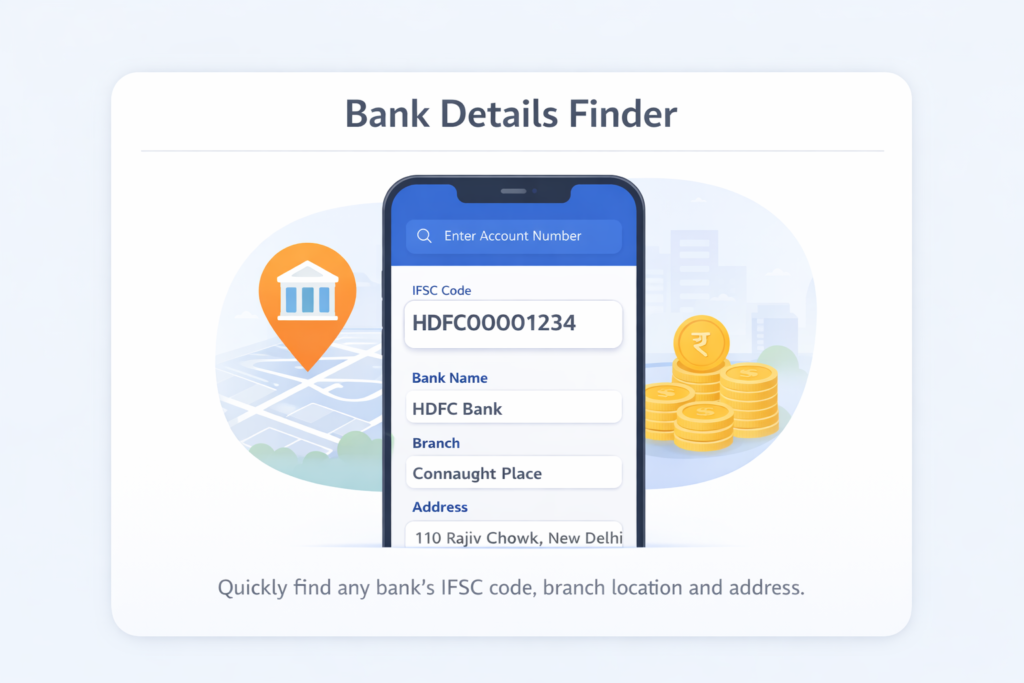
Find Your Bank’s Details Easily
Use our tool to quickly find the Bank Details you need. Just enter your IFSC Code and get all the details you require in seconds.
IFSC Code Finder
Enter IFSC code to get complete bank branch details instantly.
IFSC Code Finder India – Instantly Check Bank Details & MICR Code
If you ever transferred money online and wondered whether the IFSC code is correct, you are not alone. Every day millions of Indians send payments using NEFT, RTGS, IMPS, and UPI, and the smallest mistake in the IFSC code can delay or even cancel the transaction.
A reliable IFSC Code Finder helps you instantly verify bank branch details, MICR code, branch address, and contact information before sending money.
Moneyora’s IFSC Code Finder tool allows you to check accurate bank details in seconds so your money always reaches the correct account.
An IFSC Code Finder is an online tool that helps users identify bank branch details in India using the IFSC code. It provides information such as bank name, branch address, MICR code, district, and state, ensuring safe transactions through NEFT, RTGS, IMPS, and UPI payment systems.
What is an IFSC Code?
The Indian Financial System Code (IFSC) is an 11-character alphanumeric code assigned to every bank branch in India.
It is issued by the Reserve Bank of India (RBI) to uniquely identify bank branches during electronic transactions.
Whenever you transfer money using:
-
NEFT
-
RTGS
-
IMPS
-
UPI
The system checks the IFSC code to route the money to the correct bank branch.
Without a valid IFSC code, digital bank transfers cannot be processed.
What is an IFSC Code Finder?
An IFSC Code Finder is a banking tool that helps you quickly search and verify bank branch details.
Using this tool, you can instantly find:
✔ Bank name
✔ Branch name
✔ Branch address
✔ District and state
✔ MICR code
✔ Bank contact details
This makes it easier to verify bank information before sending money.
Moneyora provides a free IFSC Code Finder that helps users check bank details within seconds.
Structure of IFSC Code (Understanding the Format)
Every IFSC code contains 11 characters.
Example:
HDFC0001234
| Section | Meaning |
|---|---|
| First 4 letters | Bank code |
| 5th character | Always 0 |
| Last 6 characters | Branch code |
Example breakdown:
| IFSC Code | Meaning |
|---|---|
| SBIN | State Bank of India |
| 0 | Reserved |
| 123456 | Branch code |
This format ensures every bank branch has a unique identification number.
How IFSC Code Works in Banking Transactions
When you transfer money online, the banking system follows these steps:
1️⃣ Sender enters account number and IFSC code
2️⃣ Payment network checks IFSC code
3️⃣ System identifies the bank branch
4️⃣ Transaction is routed to the correct bank
If the IFSC code is wrong:
❌ Transfer fails
❌ Payment may get reversed
❌ Delay in transaction
That is why verifying bank details using an IFSC Code Finder is extremely important.
How to Use IFSC Code Finder (Step-by-Step Guide)
Using Moneyora’s IFSC Code Finder is simple.
Step 1
Open the IFSC Code Finder tool on Moneyora.
Step 2
Enter the 11-digit IFSC code.
Step 3
Click Search.
Step 4
Instantly view bank details.
You will see:
Bank name
Branch address
MICR code
State and district
This ensures your bank transfer details are accurate and verified.
Real Life Example (Indian Banking Scenario)
Imagine you want to send ₹25,000 to your friend in Delhi.
Bank Details:
| Detail | Value |
|---|---|
| Bank | ICICI Bank |
| Account Number | 123456789 |
| IFSC Code | ICIC0000456 |
Before sending the money, you use the IFSC Code Finder.
Result shows:
| Detail | Result |
|---|---|
| Bank | ICICI Bank |
| Branch | Connaught Place |
| City | New Delhi |
| MICR | 110229004 |
Now you know the details are correct and can safely send money using NEFT or IMPS.
IFSC Code vs MICR Code (Important Difference)
| Feature | IFSC Code | MICR Code |
|---|---|---|
| Length | 11 characters | 9 digits |
| Used for | Online transfers | Cheque processing |
| Issued by | RBI | RBI |
| Payment systems | NEFT, RTGS, IMPS | Cheque clearing |
Both codes help banks process transactions securely and accurately.
Why IFSC Code is Important for Online Banking
An IFSC code ensures:
Correct bank branch identification
Safe online money transfer
Faster payment processing
Reduced banking errors
Without IFSC code verification, there is a higher risk of transfer failure or payment delay.
Who Should Use IFSC Code Finder?
This tool is useful for:
Salaried employees sending bank transfers
Business owners making vendor payments
Students paying fees online
Online sellers receiving payments
Anyone using NEFT, RTGS, or IMPS
Basically, anyone who uses online banking in India.
Common Mistakes to Avoid
Many users make these mistakes while transferring money.
Entering wrong IFSC code
Using outdated bank branch codes
Copy-pasting incorrect account numbers
Sending large transfers without verification
Always verify bank details before making payments.
Pro Tips for Safe Bank Transfers
Double-check IFSC code before payment
Use official bank tools or trusted websites like Moneyora
Save verified beneficiaries in banking apps
Start with small test transfers
These simple habits can prevent financial mistakes.
RBI Guidelines for IFSC Codes
The Reserve Bank of India (RBI) regulates IFSC codes for all Indian banks.
Banks must:
Assign unique IFSC codes to branches
Update codes if branches merge
Maintain accurate banking databases
Official reference:
https://www.rbi.org.in
Explore More Financial Tools on Moneyora
You can also use other free tools on Moneyora:
Loan EMI Calculator
SIP Calculator
Credit Card EMI Calculator
Bank Details Finder
Stock Profit Calculator
These tools help users manage money smarter.
Conclusion
Online banking has made money transfers faster than ever, but entering the wrong IFSC code can cause serious delays or transaction failures.
Using a trusted IFSC Code Finder ensures that your bank details, branch information, and MICR code are accurate before sending money.
If you frequently send payments through NEFT, RTGS, IMPS, or UPI, always verify bank information first.
👉 Use the free IFSC Code Finder on Moneyora.in to instantly check bank details and make safe transactions every time.
Moneyora also works as a complete bank branch locator India that helps users perform an IFSC code search and find bank branch by IFSC. This online bank verification tool allows users to check the bank address by IFSC, perform a bank MICR number check, and verify bank contact details India. It also functions as a trusted bank IFSC lookup India system that supports UPI IFSC code search, IMPS bank IFSC search, and RTGS bank code India verification across the complete Indian banking IFSC directory.
Frequently Asked Questions – IFSC Code Finder
An IFSC Code (Indian Financial System Code) is an 11-character alphanumeric code assigned by the Reserve Bank of India to identify bank branches for electronic fund transfers such as NEFT, RTGS, and IMPS.
You can use an IFSC Code Finder tool like Moneyora to instantly check bank name, branch name, address, district, state, and MICR code by entering the IFSC code.
UPI payments usually do not require an IFSC code because they use UPI IDs. However, IFSC codes may be required when adding a bank beneficiary for traditional bank transfers.
If the IFSC code is incorrect, the bank transfer may fail or be rejected. In most cases, the transaction will be reversed automatically by the banking system.
No. Every bank branch in India has a unique IFSC code issued by the Reserve Bank of India.
Yes. IFSC codes can change when banks merge, branches relocate, or the banking structure is updated.
You can verify IFSC codes using the official RBI website or trusted banking tools like the Moneyora IFSC Code Finder.
Yes. IFSC code is mandatory for NEFT transactions because it identifies the exact bank branch receiving the funds.
MICR Code (Magnetic Ink Character Recognition Code) is a 9-digit code used by banks to process cheques quickly and securely.
Yes. IFSC codes are public banking identifiers used only to identify a bank branch and do not reveal sensitive account information.