Minimum Balance Charges Calculator
Check an illustrative average-balance shortfall and fee using your bank’s own schedule.
By Mukesh Rajbhar. Calculation methodology prepared 23 November 2026. Educational estimates.
Minimum Balance Charges Calculator inputs
On this page
What the minimum balance charges calculator measures
Average balance requirements apply to a period, so a single low daily balance does not determine the fee. This worksheet starts with the actual average already calculated from your statement. It then applies the percentage and cap from your selected bank schedule.

Understand the inputs
Required average balance
Use the requirement for your account type and branch classification. Enter a rupee amount using digits, without a currency symbol or comma. The result uses Indian number grouping, while the calculation retains precision until it is displayed.
Actual average balance
Use the period’s eligible average, not only the balance on the last day. Enter a rupee amount using digits, without a currency symbol or comma. The result uses Indian number grouping, while the calculation retains precision until it is displayed.
Fee as percentage of shortfall
Copy the applicable bank fee rule. This example does not imply a universal rate. Type the percentage itself, such as 8 for eight percent. Keep the quoted period consistent with the label; a monthly percentage and an annual percentage are different inputs.
Maximum fee before tax
Set zero where your selected schedule has no cap. Enter a rupee amount using digits, without a currency symbol or comma. The result uses Indian number grouping, while the calculation retains precision until it is displayed.
Tax rate on fee
Use the applicable tax assumption. Waivers and exemptions need a separate check. Type the percentage itself, such as 8 for eight percent. Keep the quoted period consistent with the label; a monthly percentage and an annual percentage are different inputs.
How to use the minimum balance charges calculator
Take the required average balance, measured average balance and charging convention from the terms for your specific account. Enter the fee percentage, any positive fee cap and the tax assumption. Calculate the shortfall and charge. Do not use the illustrative defaults as a bank's current tariff. Check first whether a minimum-balance requirement, exemption or waiver applies before using this percentage-of-shortfall model for a statement comparison.
Minimum Balance Charges Calculator formula
Shortfall = max(required average - actual average, 0). Fee = shortfall × fee percentage / 100, limited by a positive cap. Total = fee × (1 + tax / 100).
Calculations retain precision until display. Currency amounts are rounded to two decimal places. Displayed percentages and quantities may use more decimal places. A lender or provider can round each payment separately, so its statement can differ from this estimate.
Minimum Balance Charges Calculator example
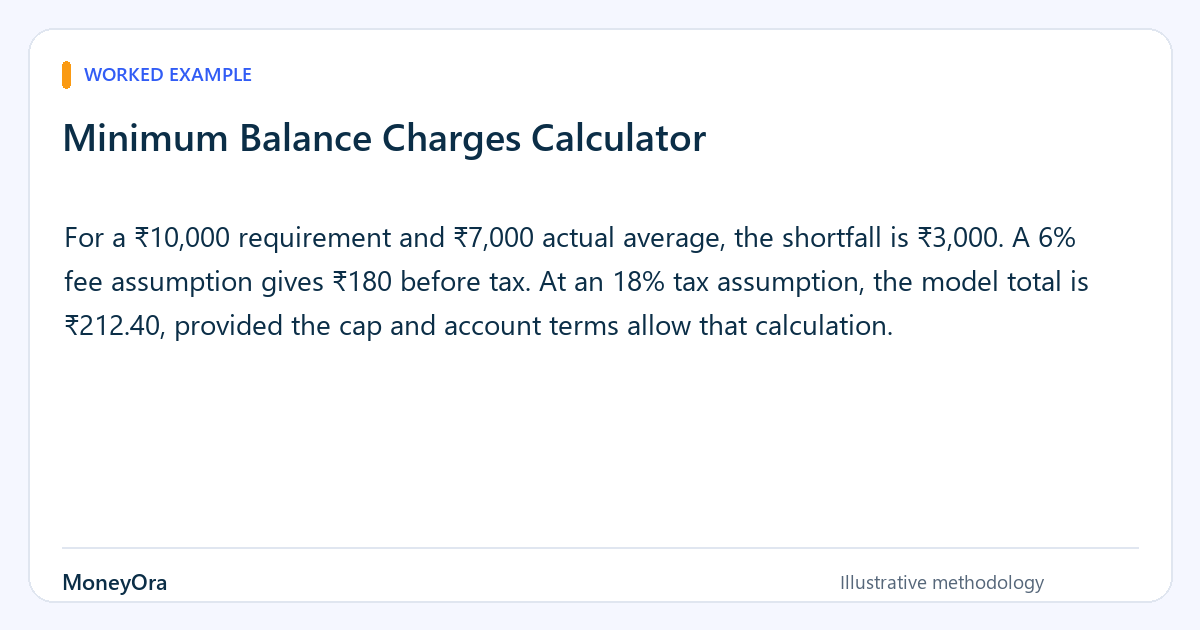
For a ₹10,000 requirement and ₹7,000 actual average, the shortfall is ₹3,000. A 6% fee assumption gives ₹180 before tax. At an 18% tax assumption, the model total is ₹212.40, provided the cap and account terms allow that calculation.
How to read the result
The model charges only a positive shortfall and applies the entered cap before tax. If the measured average meets the requirement, the modelled fee is zero. A zero or different charge on a bank statement can also reflect account eligibility, a waiver or a tariff that uses another method. This calculator does not fetch bank-specific charges, calculate an average from daily transactions or determine whether a penalty is permitted for your account.
A useful comparison
An average balance is a period measurement. Raising the closing balance on the final day may be insufficient to repair a low average across earlier days. Use the bank's required averaging period and eligible daily balances when checking the input.
The percentage and cap model cannot reproduce every bank schedule. A slab fee can jump when a threshold is crossed, while a salary or basic account may qualify for a waiver. Confirm the current account classification before applying a charge.
A computed fee is an arithmetic scenario, not a determination that recovery is permitted. Notice requirements, exemptions and protections against a balance becoming negative solely from such charges need separate checks against the actual bank terms.
Assumptions and limits
Many banks use slabs or flat fees rather than a straight percentage. Some accounts have no minimum balance requirement or qualify for waivers. This model is unsuitable for those fee schedules without an adjustment. It does not claim the bank is entitled to charge the result.

Minimum Balance Charges Calculator FAQs
Can I use this for every bank account?
No. Use it only when the bank’s rule matches a percentage of shortfall with an optional cap. Check account waivers, slabs, notice requirements and current terms before treating the result as payable.
Are my calculator inputs stored?
Ordinary numeric inputs are calculated in your browser. This calculator does not save those entries to browser storage or send them with a calculation request. A separate reference-rate request contacts a data provider through the server. Read the Privacy Policy for hosting and provider details.
What should I check if a result looks different from my statement?
Check required average balance, actual average balance, fee as percentage of shortfall, then compare the exact calculation convention stated above. A different period, unit, rounding rule or excluded charge can change the result. Send the page URL and a reproducible numerical example to support@moneyora.in if the arithmetic still appears wrong.
Sources and corrections
Use the linked primary source to verify product terms and current rules. The source explains the underlying subject; it does not certify this calculator. Report a calculation problem with the inputs and expected result so the example can be checked.
Revision prepared 24 November 2026: input and result guidance updated; formula and worked example retained.
Related bank tools
Bank
IFSC Finder
Look up bank and branch details for an Indian Financial System Code.
Home Loan Eligibility Calculator
Estimate a housing loan amount from income, existing EMIs and an affordability ratio.
Personal Loan Eligibility Calculator
Explore the personal loan principal supported by a monthly repayment budget.
Savings Interest Calculator
Estimate savings account interest from a constant daily balance and annual rate.
Credit Card EMI Calculator
Compare a card EMI’s instalments with an upfront processing fee.
Home Loan Prepayment Calculator
Estimate the tenure and interest effect of an immediate loan prepayment while keeping EMI unchanged.
Balance Transfer Calculator
Compare remaining loan interest at two rates after including transfer costs.
No matching tool. Try a shorter search or choose another category.