Staking Rewards Calculator
Estimate token rewards and compare APR with a selected reinvestment frequency.
By Mukesh Rajbhar. Calculation methodology prepared 23 November 2026. Educational estimates.
Staking Rewards Calculator inputs
On this page
What the staking rewards calculator measures
Staking rewards add token units. Their rupee value still depends on the token price when they are valued or sold. A rising token count can accompany a falling rupee balance, so the result shows units and a separate price scenario.

Understand the inputs
Tokens staked
Use token units, not their current rupee value. Keep the unit consistent with the label and your source record. A per-unit price and the value of the full holding must remain separate to avoid multiplying the quantity twice.
Nominal annual reward rate
Enter APR. A published APY already includes compounding and should not be compounded again. Type the percentage itself, such as 8 for eight percent. Keep the quoted period consistent with the label; a monthly percentage and an annual percentage are different inputs.
Time period
Enter complete years. The calculation uses the same rate throughout this period. Use a whole number for this period. The tool does not infer opening dates, holiday adjustments or partial periods from the duration alone.
Reinvestment frequency
This assumes every reward can be restaked at the chosen interval. The choice changes how the calculation treats the inputs. Keep this setting unchanged when comparing two amounts, then change it separately to see the effect of the convention.
Scenario INR price per token
Use a separate token price assumption to value the future token balance. Enter a rupee amount using digits, without a currency symbol or comma. The result uses Indian number grouping, while the calculation retains precision until it is displayed.
How to use the staking rewards calculator
Enter the number of tokens staked and a nominal annual reward-rate assumption. Choose the reinvestment frequency, projection years and a scenario INR price per token. Calculate, then compare a different token-price assumption without changing the reward rate. Check whether a provider quotes APR or an already compounded yield before choosing an input, and confirm whether the assumed reinvestment schedule is actually available.
Staking Rewards Calculator formula
Future tokens = staked tokens × (1 + APR / (100 × frequency))^(frequency × years). Rewards = future tokens - starting tokens.
Calculations retain precision until display. Currency amounts are rounded to two decimal places. Displayed percentages and quantities may use more decimal places. A lender or provider can round each payment separately, so its statement can differ from this estimate.
Staking Rewards Calculator example
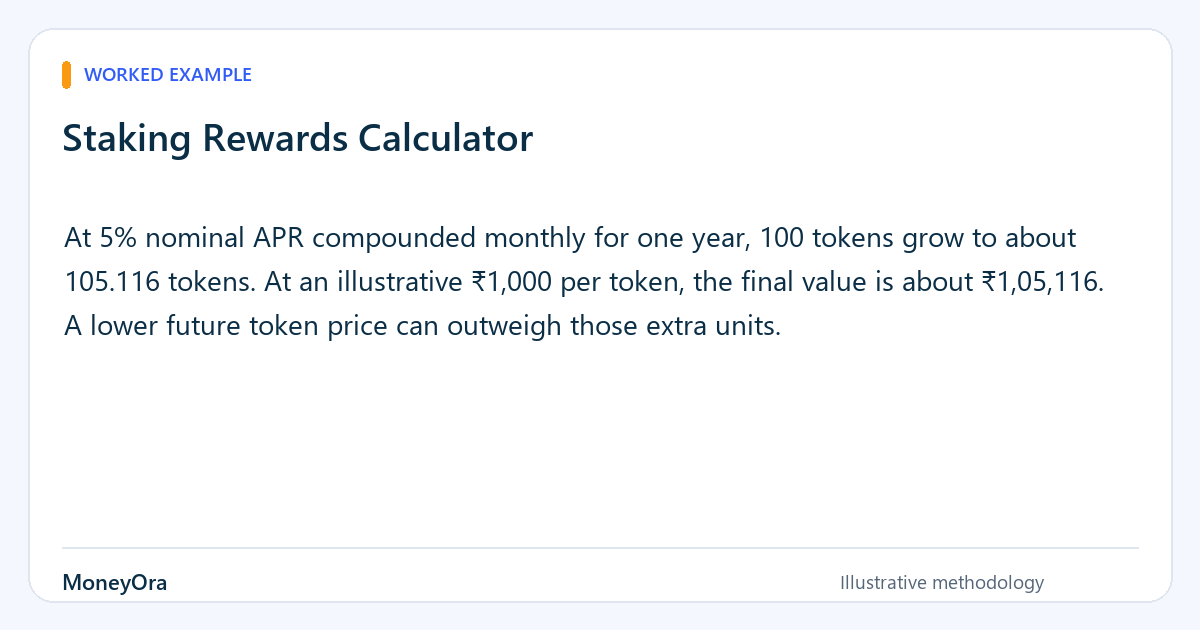
At 5% nominal APR compounded monthly for one year, 100 tokens grow to about 105.116 tokens. At an illustrative ₹1,000 per token, the final value is about ₹1,05,116. A lower future token price can outweigh those extra units.
How to read the result
Rewards and future balance are measured in tokens before the selected INR price is applied. Compounding a nominal APR is different from entering an already compounded APY as that APR. More tokens can still be worth fewer rupees if the market price falls. The projection excludes changing reward rates, validator commission, slashing, lockups and network costs; it does not assess whether a staking arrangement can meet the modelled schedule.
A useful comparison
Separate token growth from rupee growth. Rewards increase the number of tokens under the assumed schedule, while the price field gives those tokens one selected rupee value. The token count can rise even when a fall in market price leaves the total rupee value below the original investment.
A quoted APR and an APY are different conventions. This tool treats the rate as nominal APR and calculates compounding through the selected reinvestment frequency. Entering an already compounded APY as APR and compounding it again would overstate rewards.
Automatic reinvestment also assumes rewards can be restaked when the model schedules it. Real arrangements may have minimum amounts, waiting periods, validator commissions, withdrawal queues or lockups. Penalties, protocol failure and custody risk are excluded. Confirm whether rewards are denominated in the same token as the amount staked before applying the future token count to a price.
Assumptions and limits
The model excludes validator fees, lock-up restrictions, slashing, protocol changes and tax. Rewards may not arrive or reinvest at equal intervals. A platform marketing yield can involve lending or other risks that differ from protocol staking.
Staking Rewards Calculator FAQs
Should I enter APY in the APR field?
Use APR when selecting a compounding frequency. APY already includes the stated compounding effect. Entering APY and compounding again would overstate the reward scenario.
Are my calculator inputs stored?
Ordinary numeric inputs are calculated in your browser. This calculator does not save those entries to browser storage or send them with a calculation request. A separate reference-rate request contacts a data provider through the server. Read the Privacy Policy for hosting and provider details.
What should I check if a result looks different from my statement?
Check tokens staked, nominal annual reward rate, time period, then compare the exact calculation convention stated above. A different period, unit, rounding rule or excluded charge can change the result. Send the page URL and a reproducible numerical example to support@moneyora.in if the arithmetic still appears wrong.
Sources and corrections
Use the linked primary source to verify product terms and current rules. The source explains the underlying subject; it does not certify this calculator. Report a calculation problem with the inputs and expected result so the example can be checked.
Revision prepared 24 November 2026: input and result guidance updated; formula and worked example retained.
Related digital coin tools
Digital Coin
Crypto Profit Calculator
Estimate a cryptocurrency trade’s profit or loss in INR after entered fees.
Bitcoin to INR
Convert a BTC quantity into rupees with a fetched reference quote or an entered rate.
Crypto SIP Calculator
Explore a fixed monthly crypto investment under a stated return scenario.
Crypto Tax Calculator
Estimate tax on an entered positive VDA gain with an explicit rate, surcharge and cess scenario.
Ethereum to INR
Convert an ETH quantity into INR using an attributed reference price or your own quote.
Crypto Portfolio Calculator
Compare the cost and present value of two crypto holdings in rupees.
No matching tool. Try a shorter search or choose another category.